New Industry Report Outlines Strategic Defense Frameworks Against Harvest Now, Decrypt Later Quantum Threats

TL;DR
- HNDL attacks involve stealing encrypted data now to decrypt it later via quantum computers.
- Data with a long shelf life, such as medical or government records, is most vulnerable.
- Organizations must accelerate the transition to post-quantum cryptographic (PQC) standards.
- Modern encryption like RSA-2048 is becoming increasingly susceptible to future quantum hardware.
- CISOs face an urgent need to reform infrastructure before the quantum horizon arrives.
The Quantum Time Bomb: Why "Harvest Now, Decrypt Later" Can't Wait
The Cloud Security Alliance (CSA) Labs just dropped a report that should be keeping every CISO awake at night. They’ve officially put a target on the back of "Harvest Now, Decrypt Later" (HNDL) attacks, labeling it a critical risk for modern AI infrastructure. The message is blunt: if you aren’t already sprinting toward post-quantum cryptographic (PQC) standards, you’re already behind.
The threat is simple in theory but catastrophic in practice. Adversaries are currently vacuuming up encrypted data, hoarding it in digital silos, and playing the long game. They don’t need to break your encryption today; they just need to wait for the day—often called "Q-Day"—when cryptographically relevant quantum computers (CRQCs) hit the scene. Once they have your data, they have it forever. You can’t "un-steal" a file that’s already sitting on a foreign server.
The Anatomy of the HNDL Trap
Think of HNDL as the ultimate passive heist. It operates in a clean, three-act cycle: intercept the traffic, stash it in a secure repository, and wait for the quantum hardware to mature. Because the collection phase is entirely silent, there’s no alarm, no tripped wire, and no "access denied" notification. It’s a ghost attack.
The vulnerability is rooted in our reliance on classical public-key cryptography—specifically RSA and elliptic-curve methods. For years, we assumed breaking these would require a massive, theoretical quantum machine with millions of physical qubits. But the goalposts have moved. Recent research suggests we might be looking at fewer than 100,000 qubits to crack RSA-2048. That’s not a sci-fi fantasy; that’s an engineering challenge that’s being solved, piece by piece, right now.
The Clock is Ticking: Risk Modeling
In the world of cloud and telecom, HNDL is a math problem defined by time. As highlighted in MDPI Telecom, your risk is the gap between how long your data needs to stay secret ($L_d$) and how long until a quantum computer can read it ($H_a$). If your data has a shelf life of ten years—think medical records, trade secrets, or government intelligence—and the quantum horizon is closing in, you are already in the danger zone.
This is particularly brutal for 5G and 6G networks, which act as massive funnels for metadata. Here is how the risk breaks down:
| Risk Factor | Description | Impact |
|---|---|---|
| Data Lifetime | How long the data must remain confidential. | High for government/medical records. |
| Decryption Horizon | Time until quantum hardware is available. | Estimated by many to be by 2030. |
| Exfiltration | The passive theft of encrypted traffic. | Undetectable by traditional means. |
| Quantum Maturity | Advancement of Shor's algorithm. | Lowers the threshold for breaking RSA. |
The Regulatory Hammer
Governments aren't sitting on their hands. NIST finalized its initial PQC standards—FIPS 203, 204, and 205—back in August 2024, effectively drawing a line in the sand. We are looking at a hard deprecation of RSA and elliptic curve cryptography by 2035.
If you’re in the national security space, the deadline is even tighter. The NSA’s CNSA 2.0 suite mandates that new systems start supporting quantum-safe algorithms by January 1, 2027. This isn't just a suggestion; it’s the new benchmark for any enterprise that wants to stay relevant.
Moving Toward Crypto-Agility
If you’re waiting for a "silver bullet" to fix this, stop. The only way forward is "crypto-agility." You need to build systems that aren't married to a single cryptographic primitive. If an algorithm becomes vulnerable, you should be able to swap it out without tearing your entire infrastructure down to the studs.
How do you start? It’s a process of triage:
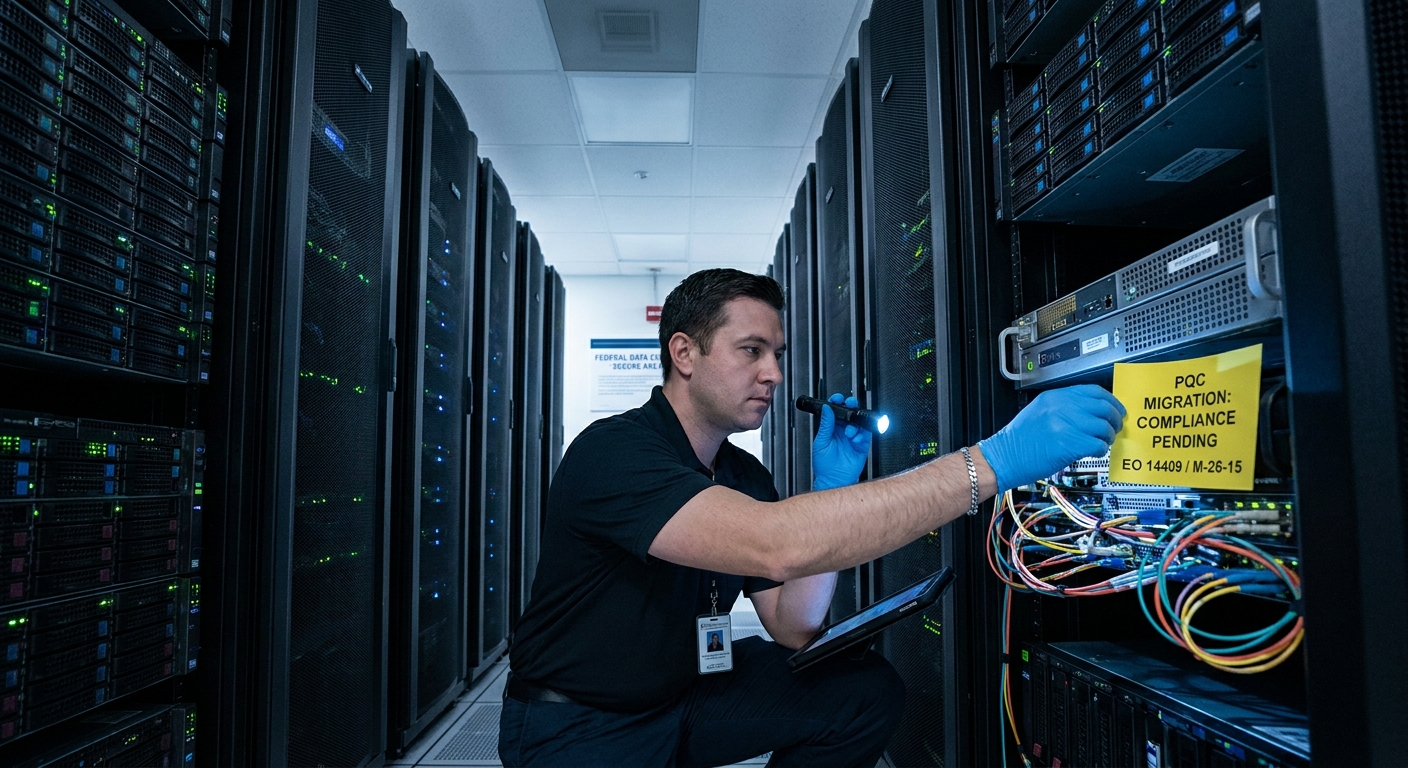
- Audit Your Assets: You can't protect what you don't know you have. Map out every instance of public-key encryption in your environment.
- Prioritize the "Forever" Data: Not all data is equal. Focus first on the information that needs to remain secret for decades—intellectual property, model weights, and sensitive personal data.
- Integrate PQC Early: Align your roadmap with the 2027 and 2035 milestones. Don't wait for the last minute to patch in NIST-approved algorithms.
- Watch the Egress: Even if the data is encrypted, watch for anomalous traffic patterns. If you see massive, unexplained data movement, assume the worst.
As noted by Palo Alto Networks, this migration is a heavy lift. It requires massive lead time. If you wait until we have a functional quantum computer to start securing your data, you’ve already lost the game.
This is especially true for AI. Your AI models are only as secure as the data used to train them. If an adversary harvests your training sets and model logs today, they can reverse-engineer your competitive advantage the moment they get their hands on a quantum processor. The CSA Labs research makes it clear: AI infrastructure is a prime target, and it requires an immediate, prioritized shift to quantum-resistant standards.
We are staring down 2030—the year many experts point to as the dawn of the quantum-capable era. The combination of finalized NIST standards and the clear, documented reality of HNDL gives you all the justification you need to start moving today. Don't wait for the future to arrive; build the defense now.