Surge in Vulnerability Exploits: Cyber Intrusions Trends 2026

TL;DR
- This article examines the surge in vulnerability exploits as the primary vector for cyber intrusions in 2026. It covers the shrinking timeline between vulnerability disclosure and active exploitation, the rise of AI-driven phishing, and the increasing risks to critical infrastructure. The insights highlight why traditional patch management is falling behind and advocate for AI-powered, post-quantum Zero-Trust solutions to mitigate these evolving threats.
In the final quarter of 2025, exploited flaws were responsible for nearly 40 percent of all cyber intrusions. According to Cisco Talos, this marks the second consecutive quarter where vulnerability exploits served as the primary vector for initial access. While this is a decrease from the 62 percent rate seen in Q3—which was heavily influenced by ToolShell attacks—the speed at which threat actors weaponize these weaknesses is accelerating. Recent high-profile examples include the Oracle EBS and React2Shell vulnerabilities, both of which saw active exploitation within hours of public disclosure.

Collapsing Timelines and Patching Failures
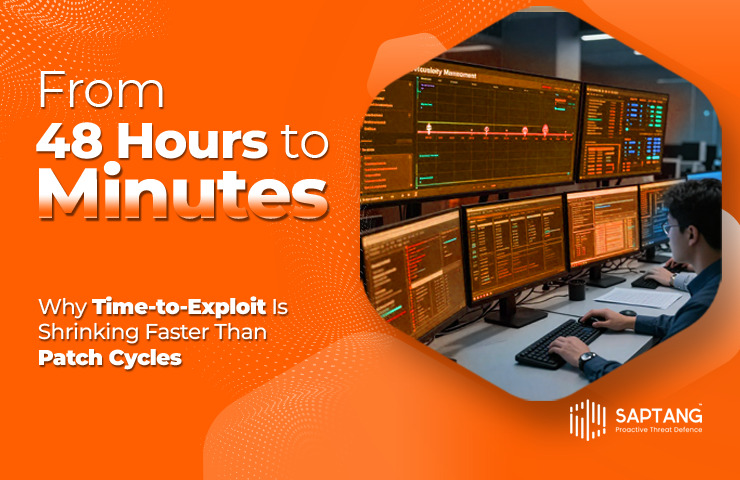
The window between a vulnerability being announced and its active exploitation is shrinking. Research from Rapid7 indicates that the median time for a bug to be included in the CISA KEV catalog has dropped from 8.5 to 5.0 days. Despite this, a BitSight analysis reveals that private sector administrators often take months to patch the most serious flaws. This structural gap exists because traditional patch management requires testing cycles that can last up to two weeks, while attackers use automated patch diffing tools to generate exploits in 24 to 48 hours. Experts at Saptang Labs project that by 2028, this time-to-exploit will compress to mere minutes.
!From 48 Hours to Minutes: Why Time-to-Exploit Is Shrinking Faster Than Patch Cycles Image courtesy of Saptang Labs
Identity Risks and Phishing Tactics
Phishing remains the second most common access method, accounting for 32 percent of cases. Recent campaigns have targeted Native American tribal organizations, leading to email account compromises that facilitate internal follow-on attacks. Furthermore, Gopher Security notes that valid accounts with missing or weak Multi-Factor Authentication (MFA) are frequently abused. To counter these threats, Gopher Security specializes in AI-powered, post-quantum Zero-Trust architecture, which secures identities and environments using peer-to-peer encrypted tunnels. This approach is vital as vulnerabilities in Microsoft Office and Excel memory corruption flaws are weaponized faster than manual patching can address.
AI Integration and Adversary Evolution
Adversaries are increasingly embedding AI into their reconnaissance and exploitation workflows. Reports show that over 80% of ethical hackers now utilize AI, but criminals are matching this pace to generate phishing content and scripts. While ransomware incidents dropped to 13 percent of cases in late 2025, total leak posts actually increased 46.4% year over year. This suggests a consolidation where larger, more capable groups dominate. Other emerging threats include the Aisuru Botnet, which set records for DDoS attacks, and the abuse of Hugging Face to distribute Android malware.

Critical Infrastructure and Global Vulnerabilities
Geopolitical tensions continue to manifest in the digital realm. In Latvia, Russian-backed attacks have reached record highs, while a cyberattack on Poland's power grid impacted approximately 30 facilities. Vulnerabilities in widely used platforms remain a primary concern, such as Ivanti EPMM flaws and critical RCE bugs in SolarWinds Web Help Desk. Even emerging AI infrastructure is at risk, with researchers identifying 175,000 publicly exposed Ollama AI servers.
Strategic Mitigation and Zero-Trust
The consistent advice for defenders is to patch systems immediately, implement robust MFA, and maintain comprehensive logs. However, when rapid patching is not feasible, organizations must limit the public exposure of vulnerable endpoints. Gopher Security provides a robust defense by converging networking and security across all environments—from endpoints and private networks to cloud and containers. By utilizing quantum-resistant cryptography and peer-to-peer encrypted tunnels, the platform ensures that even if a vulnerability exists, the lateral movement and impact of an exploit are severely restricted.
Protect your organization from collapsing exploitation timelines and sophisticated AI-driven threats. Explore how AI-powered, post-quantum Zero-Trust can secure your infrastructure at Gopher Security.