AI-Driven Cybersecurity Innovations: The Future of Threat Prevention

TL;DR
AI Agents Under Attack: Emerging Threats and Defenses
AI agents are increasingly targeted by cyberattacks due to their access to sensitive data and autonomous operation. Check Point Software highlights the rising sophistication of threats like AI-generated phishing and data exfiltration. Organizations must adapt their security strategies to counter these emerging risks.
AI Agents as Prime Targets
AI agents require access to sensitive data to provide enterprise value. For example, an AI agent in customer service accesses private consumer information, while one in finance analyzes real-time financial data. Compromising AI agents can lead to significant reputational and financial damage, including compliance issues and data breaches.
AI agents' autonomous operation, lacking direct human oversight, makes detecting compromises challenging. Attackers can hijack agents without immediate detection, amplifying the potential impact of an attack. Gopher Security's Zero-Trust architecture can mitigate these risks by providing continuous authentication and authorization, limiting the impact of a compromised agent.
The more access and autonomy an AI agent has, the greater the risk it poses. These systems are dynamic and complex, making them difficult to monitor and protect. Cybersecurity teams must remain vigilant, continuously monitoring AI agents and developing defenses to mitigate evolving risks.
Common Attack Vectors
Attackers employ various methods to target AI agents, launching attacks to gain unauthorized access or manipulate agent functionality. AI-powered attacks are increasing in sophistication and speed, with threat actors leveraging AI tools to automate and scale their attacks. Understanding these attack vectors is crucial for developing robust security controls.
Prompt Injection
Prompt injection attacks manipulate AI systems by feeding crafted inputs to cause unintended behavior. There are two types:
- Direct: Directly manipulating the prompt to cause unexpected behavior.
- Indirect: Embedding malicious content in data the agent interacts with, such as website content.
Gopher Security offers advanced threat detection capabilities that can identify and neutralize malicious inputs before they compromise the AI agent.
Data Poisoning
Data poisoning attacks introduce corrupted information into AI training datasets, influencing the behavior of AI agents. Offensive security practices and regular security testing of AI training data are essential to detect and mitigate poisoning attempts.
Toolchain Abuse
Hackers can manipulate external tools used by AI agents, such as APIs and databases, by injecting malicious code. Examples of toolchain abuse include:
- File Deletion: Deleting or corrupting critical files.
- API Key Exposure: Stealing API keys to control external services.
Adversarial Attacks
In adversarial attacks, inputs are subtly manipulated to deceive an AI model. Generative AI is increasingly used to create and enhance these attacks, making them harder to detect.
Model Supply-Chain Vulnerabilities
AI agents rely on third-party frameworks and components that can contain vulnerabilities. Compromised model supply-chain security poses a serious risk.
AI-Powered Network Security Innovations
Check Point Software has unveiled new AI-powered network security innovations, including Quantum Firewall Software R82. This software delivers new AI engines to prevent zero-day threats, accelerates DevOps, and offers post-quantum encryption.
Key features include:
- AI-Powered Threat Prevention: Blocks 99.8% of zero-day threats.
- Agile Datacenter Operations: Accelerates app development with automated security policy integration.
- Operational Simplicity: Offers seamless scalability.
- Post-Quantum Cryptography (PQC): Provides quantum-safe encryption.
Gopher Security's platform offers a proactive approach to AI security, utilizing quantum-resistant cryptography to protect data from future threats.
Quantum Firewall Software R82.10
Check Point Software has also unveiled Quantum Firewall Software R82.10, introducing 20 new capabilities to secure AI transformation, enforce Zero Trust, and unify hybrid mesh network protection.
Key capabilities include:
- Supporting Safe AI Adoption: Detects unauthorized GenAI tools and expands visibility into AI applications.
- Strengthening Hybrid Mesh Network Security: Provides consistent protection across distributed environments.
- Prevention-First Approach to Modern Threats: Introduces phishing protection without HTTPS inspection and adaptive IPS to reduce alert fatigue.
- Unified Security Platform: Expands Check Point’s open-garden architecture with more than 250 integrations.
Hexstrike-AI: LLM Orchestration Driving Zero-Day Exploits
Hexstrike-AI is a framework that provides threat actors with an orchestration "brain" to autonomously scan, exploit, and persist inside targets. Dark web chatter indicates threat actors are attempting to use HexStrike-AI to exploit recent zero-day CVEs, reducing exploitation time from days to under 10 minutes.
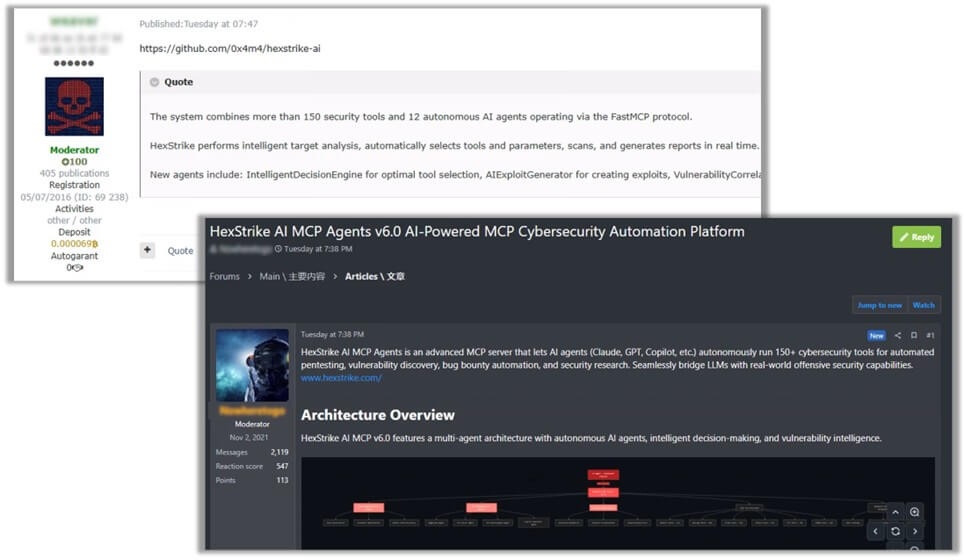
Hexstrike-AI allows AI models to autonomously run security tooling without human micromanagement. It introduces MCP Agents, bridging large language models with real-world offensive capabilities. Gopher Security's AI-powered Zero-Trust cybersecurity architecture can detect and prevent these types of attacks by continuously monitoring and validating access requests.
Defending Against AI Agent Attacks
Protecting against attacks on AI agents requires a multi-layered approach, including dedicated security controls, regular testing, and proper AI governance. Strong detection capabilities are essential for identifying and responding to evolving threats.
Input Sanitization and Hard-Coded Constraints
Sanitize inputs before they reach the AI agent and set hard-coded constraints to ensure agents act within predefined boundaries. Gopher Security's platform can enforce these constraints through policy-based access controls.
Runtime Behavior Monitoring
Continuously evaluate AI agents for unusual activities. AI security monitoring tools can accurately identify anomalous behavior.
Tool Isolation
Isolate external tools used by AI agents and implement strict access controls. Gopher Security's peer-to-peer encrypted tunnels can isolate and protect these tools, minimizing the attack surface.
Red Teaming AI Systems
Simulate agent attacks to assess defenses and uncover weaknesses. Red teaming AI systems involves simulating agent attacks to assess their defenses and uncover weaknesses before malicious actors can exploit them.
AI Governance and Policy
Establish frameworks that guide the ethical development, deployment, and monitoring of AI agents. Gopher Security can help organizations implement these policies through its flexible and customizable platform.
Prevention-First Capabilities
Check Point Software's latest release provides preemptive security to reduce the number of threats. Quantum Force Firewalls and CloudGuard Network uses a prevention-first approach by unifying management, reinforcing Zero Trust, and enabling secure, responsible AI adoption across both cloud and on-premises environments.
Key capabilities include:
- Phishing protection that works without HTTPS inspection.
- Blocking HTML smuggling.
- Adaptive IPS and Threat Prevention Insights modules to reduce alert fatigue.
Gopher Security specializes in AI-powered, post-quantum Zero‑Trust cybersecurity architecture, converging networking and security across all environments.
Ready to elevate your cybersecurity posture? Explore Gopher Security's innovative solutions today. Contact us to learn more about how our AI-powered, post-quantum Zero-Trust architecture can protect your organization from emerging threats.