Global Enterprises Accelerate PQC Migration Strategies to Counter Harvest Now Decrypt Later Quantum Threats

TL;DR
- Adversaries are stealing encrypted data now to decrypt with future quantum computers.
- Cryptographically Relevant Quantum Computers (CRQCs) could arrive as early as 2028.
- Current encryption standards like RSA and ECC are vulnerable to Shor’s algorithm.
- Organizations must prioritize PQC migration to secure long-term sensitive information.
- Only a small fraction of enterprises have deployed quantum-safe encryption protocols.
The Quantum Clock is Ticking: Why "Harvest Now, Decrypt Later" is Already Your Problem
The threat of a quantum-enabled cyberattack used to be the stuff of sci-fi speculation—a distant, theoretical "what if" for the next generation of security professionals to worry about. Not anymore.
We are currently staring down the barrel of "Harvest Now, Decrypt Later" (HNDL) attacks. It’s a simple, brutal strategy: bad actors are vacuuming up encrypted data today, hoarding it in massive data lakes, and waiting for the day a Cryptographically Relevant Quantum Computer (CRQC) comes online to crack it open like a walnut. With experts now pulling their timelines forward to 2028–2030, the "distant future" has suddenly become a three-year sprint. If your data needs to stay secret for more than a few years, you are already in the crosshairs.
The logic here is cold and irreversible. You can’t "un-intercept" a packet of data that’s already been exfiltrated. Once it’s in the hands of an adversary, its security isn't just compromised; it’s on a countdown clock.
The Math Problem That Changes Everything
At the heart of the modern internet lies public-key encryption—the digital handshake that keeps your banking, email, and classified comms private. It relies on mathematical puzzles that are nearly impossible for classical computers to solve, like factoring massive integers.
Enter Shor’s algorithm. It’s the quantum equivalent of a skeleton key. Once a fault-tolerant quantum computer exists, the math that protects RSA and elliptic-curve cryptography (ECC) effectively collapses.
The HNDL playbook is straightforward and terrifyingly effective:
- The Grab: Adversaries scrape encrypted traffic or breach databases, siphoning off everything they can get their hands on.
- The Cold Storage: This data is tucked away in offline storage, sitting idle while the adversary waits for the hardware to catch up.
- The Payoff: The moment a CRQC hits the scene, the "vault" is opened. Intellectual property, government secrets, and personal records are laid bare.
Research published in MDPI Computers has effectively shattered the illusion that we have a decade or two to prepare. The window for a quantum-capable threat has compressed to 2028–2030. For organizations that haven't even begun their cryptographic audit, this acceleration is a wake-up call that’s ringing off the hook.
Why Are We So Unprepared?
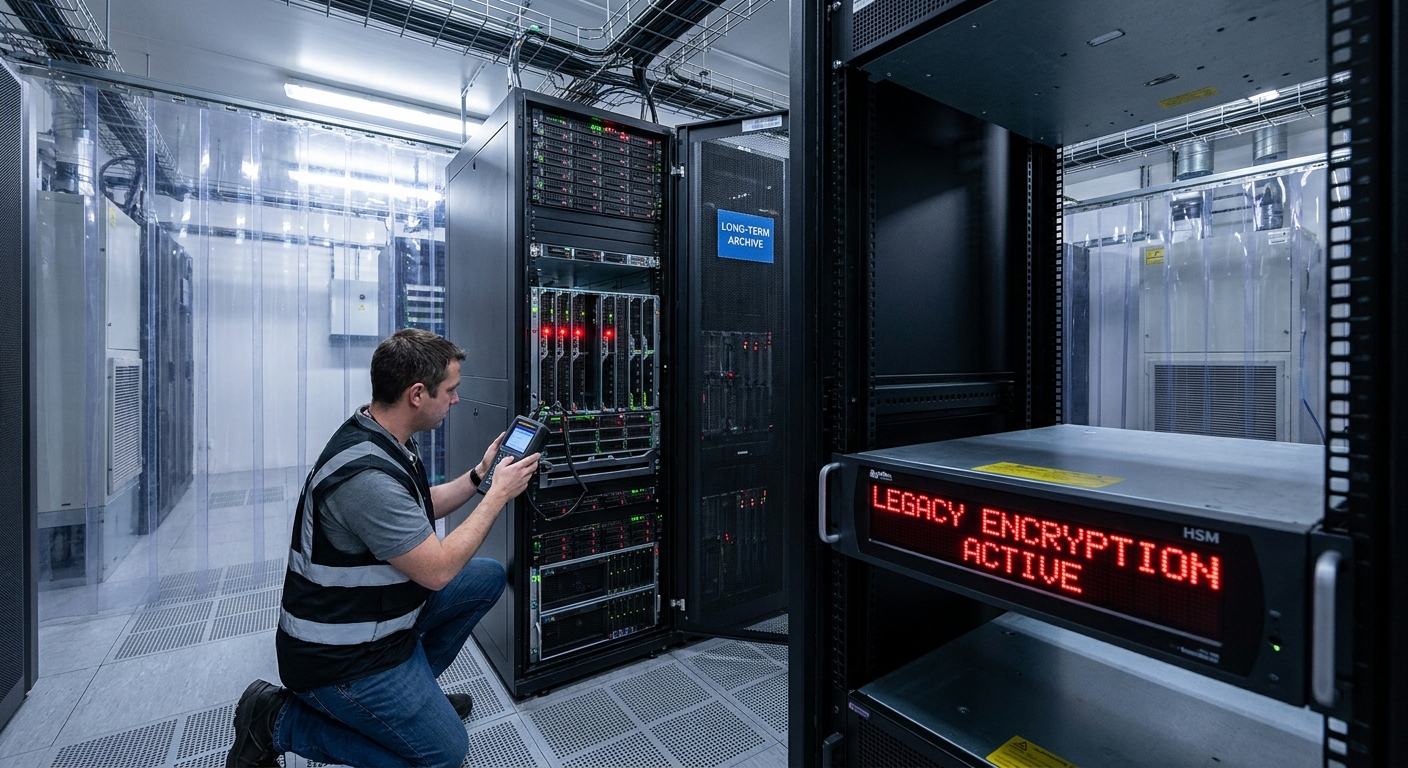
If the threat is so clear, why aren't we ready? A survey from May 2025 painted a grim picture: a measly 5% of enterprises have successfully deployed quantum-safe encryption. Even worse, 81% of those surveyed admitted their current cryptographic libraries and hardware security modules (HSMs) are essentially dinosaurs—they simply can't handle the requirements of Post-Quantum Cryptography (PQC).
This isn't a "patch Tuesday" fix. Moving to PQC is a total architectural overhaul. It’s like trying to swap out the engine of a jet while it’s mid-flight.
| Technical Factor | Impact of PQC Migration |
|---|---|
| Certificate Sizes | 5–10x increase compared to RSA/ECC |
| Signature Generation | Increased latency and processing time |
| Hardware/Firmware | Requires widespread replacement of legacy HSMs |
| Supply Chain | Coordination required across third-party vendors |
The Cloud Security Alliance (CSA) Labs has been sounding the alarm, especially now that NIST has finalized FIPS 203, 204, and 205. We finally have the rulebook, but having the standards and having the infrastructure are two very different things. The gap between knowing what to do and actually doing it is where the vulnerability lives.
Moving Toward Cryptographic Agility
If you’re managing sensitive data—think healthcare records, financial ledgers, or high-value IP—you have to assume that anything intercepted today is already "compromised" in the eyes of a future quantum adversary.
So, what’s the move? You don't overhaul everything overnight. You start with "cryptographic agility."
- Prioritize the Crown Jewels: Identify the data that needs to stay secret for the longest period. That’s your first line of defense.
- Go Hybrid: Many firms are adopting hybrid modes, wrapping their existing classical encryption in a layer of quantum-resistant algorithms. It’s a "belt and suspenders" approach that ensures if one layer fails, the other holds.
- Audit the Supply Chain: You’re only as quantum-safe as your weakest vendor. If your third-party partners aren't on the same page, your migration is effectively moot.
As noted in the strategic research from the Cloud Security Alliance, this is a systemic challenge that requires buy-in from IT, legal, and the C-suite. It’s not just an IT upgrade; it’s a fundamental shift in how we define organizational resilience.
The Harvest Now, Decrypt Later threat doesn't care about your current operational constraints. It doesn't care that your legacy hardware is expensive to replace or that your network latency is already tight. It only cares about the data. As we head toward the end of the decade, the focus must shift from passive monitoring to active, quantum-hardened infrastructure. The clock is ticking, and the data is already being harvested. Are you ready for what happens when the vault opens?