Beyond Traditional Defense: Advanced Threat Detection for Post-Quantum AI

TL;DR
- ✓ Learn how Store Now Decrypt Later attacks threaten your sensitive AI training data.
- ✓ Understand why legacy TLS and RSA encryption are vulnerable to quantum computing threats.
- ✓ Discover risks associated with using Model Context Protocol without quantum-resistant security measures.
- ✓ Implement dual-layered, quantum-resistant architecture to future-proof your organizational intellectual property.
Your data has an expiration date, and right now, the clock is running out.
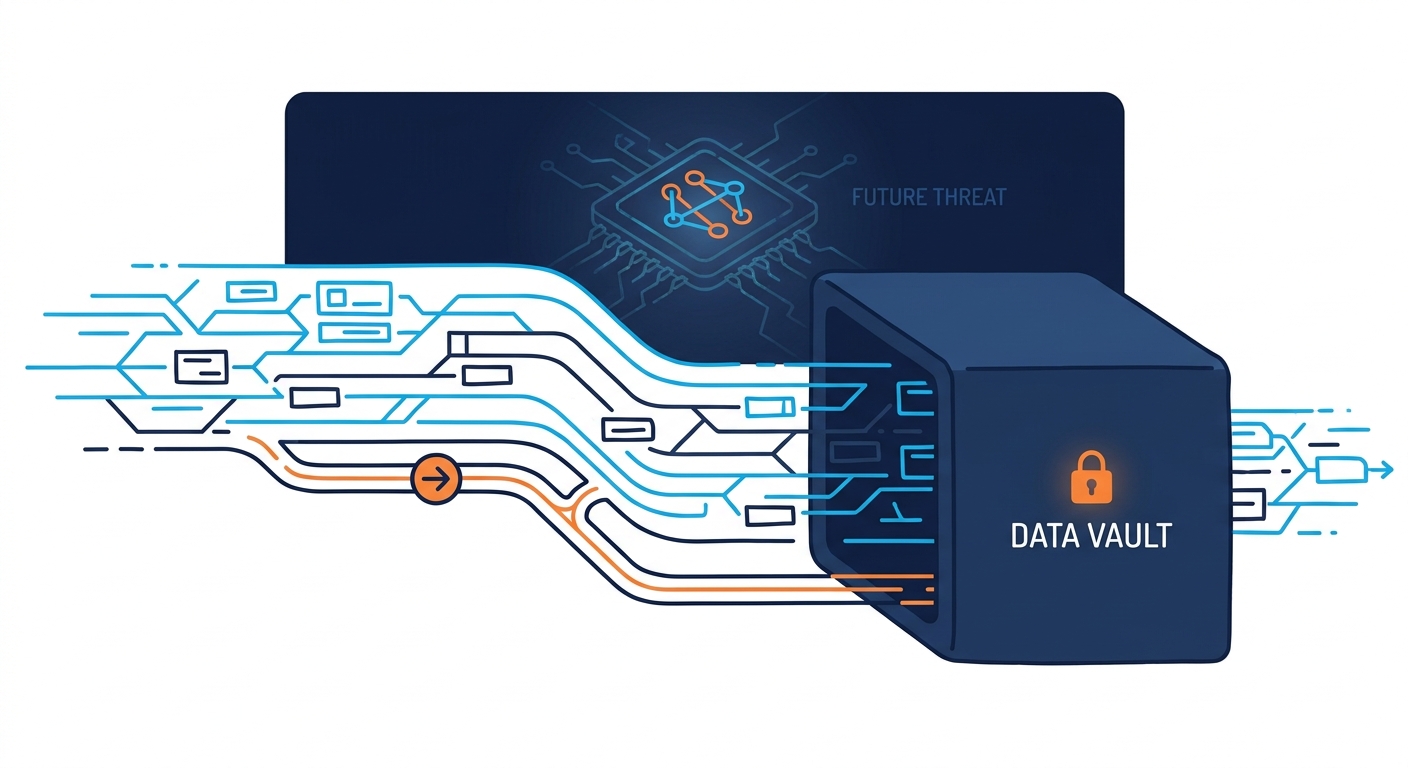
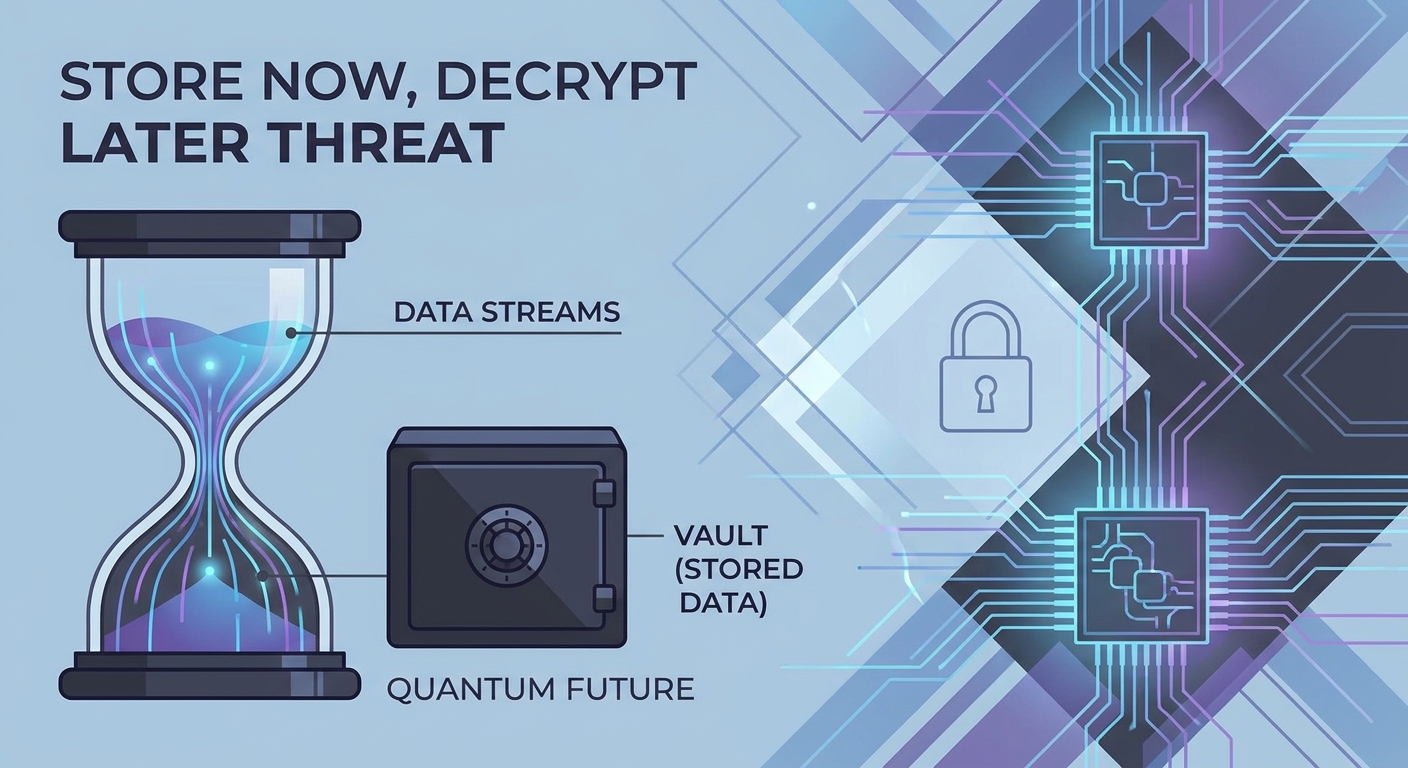
Most enterprise security teams are currently obsessed with the "loud" problems: prompt injections, LLM hallucinations, and runaway agents. Meanwhile, a quiet, shadow threat is harvesting your most sensitive AI traffic. They aren't looking for an immediate payday. They’re storing your encrypted data today with the explicit intent to crack it tomorrow.
Welcome to the "Store Now, Decrypt Later" (SNDL) crisis.
Adversaries are recording your encrypted communications, betting that within a few years, fault-tolerant quantum computers (FTQCs) will make today’s RSA and ECC encryption look like a child’s padlock. If your organization is already hooked into the Model Context Protocol (MCP), this isn't some distant, sci-fi scenario. It is a clear and present danger to your intellectual property, your proprietary training data, and the sensitive context passing between your agents and servers.
We have to stop pretending that legacy TLS is a vault. It’s a screen door. It’s time to adopt a dual-layered, quantum-resistant architecture—and we need to do it before the window of protection slams shut.
Why your AI infrastructure is built on sand
Our entire digital economy rests on a foundation of math that keeps the internet honest: RSA and Elliptic Curve Cryptography. These systems rely on the fact that factoring massive numbers is an insanely difficult task for classical computers.
To a standard server, these are Herculean problems. To a sufficiently powerful quantum computer? They’re child’s play. If you look at the CISA Quantum Readiness guidelines, you’ll see the writing on the wall: the transition to quantum-safe standards isn't a "nice to have" for the future. It’s a requirement for data integrity today.
The Model Context Protocol (MCP) has been a godsend for interoperability. It lets AI agents pull context from everywhere, dynamically and efficiently. But that efficiency comes with a price. MCP is built on standard transport layers, which means it inherits every weakness those layers possess. If the transport layer is compromised, your "context" stops being a set of instructions and becomes an open book for any actor with the patience to archive your traffic.
When your AI agents trade business logic or private customer data, they are essentially broadcasting your secrets into a future where the lock has already been picked.
The shadow of "Store Now, Decrypt Later"
We are watching a fundamental shift in how nation-state actors and sophisticated cyber-criminals operate. According to current Harvest Now, Decrypt Later research, the desire to unlock historical data is the primary driver for the massive, silent harvesting operations happening right now.
For AI, the stakes are uniquely high. Think about your AI logs. They aren't just transient web sessions. They contain the "crown jewels": the prompts, the retrieved documents, the RAG (Retrieval-Augmented Generation) context, and the specific decision-making patterns that define your agents.
If an attacker gets their hands on this cache five years from now, they don't just get a list of transactions. They get a blueprint of your entire AI-driven business strategy. If your security budget ignores this, you are quite literally building on sand.
Surviving the transition: The Hybrid Cryptography Pivot
The good news? You don't have to "rip-and-replace" your entire production environment and bring it to a grinding halt. Instead, the industry is moving toward "Cryptographic Agility."
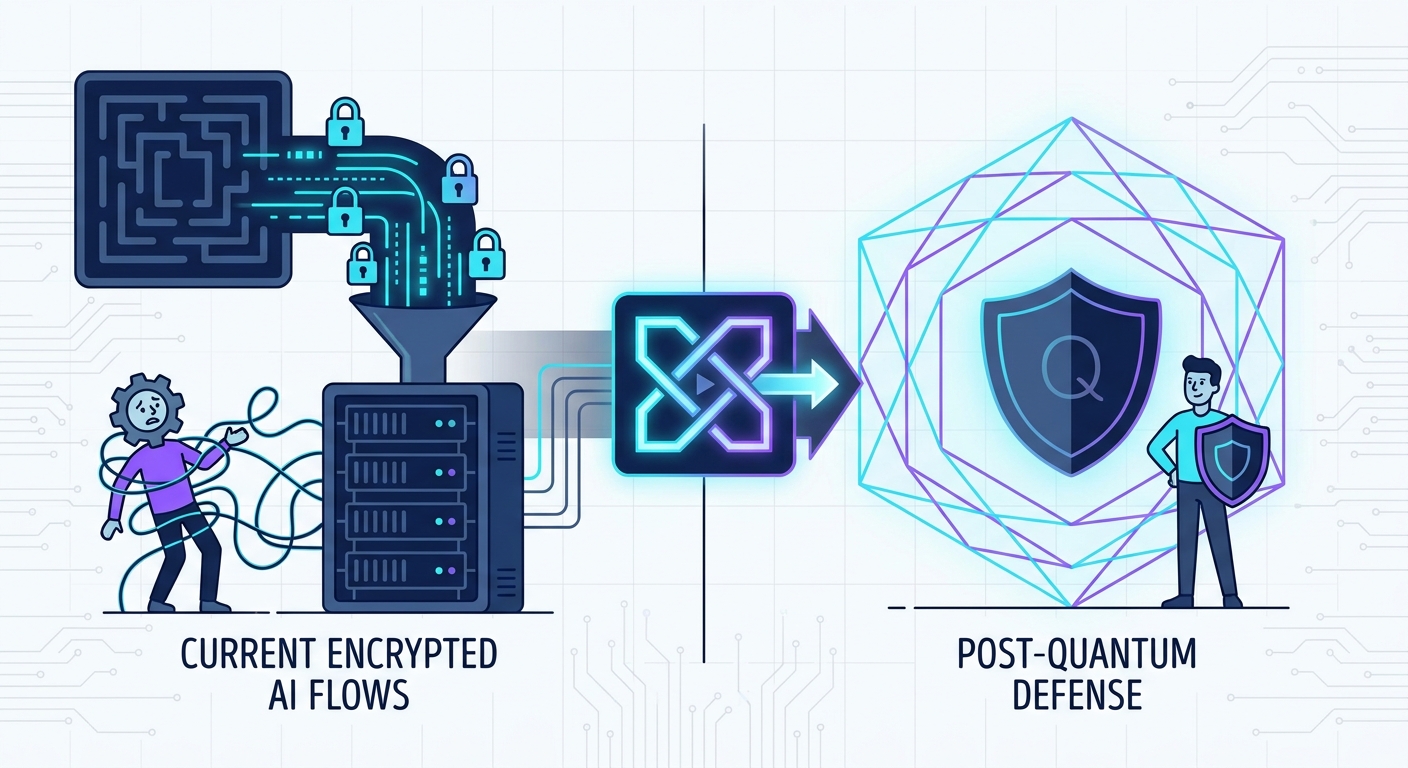
The strategy here is simple: implement hybrid models that pair established, classical algorithms with post-quantum key encapsulation mechanisms (KEMs). A prime example is ML-KEM (Kyber), which is currently leading the pack in NIST Post-Quantum Cryptography Standardization.
By running a hybrid handshake, you get the best of both worlds. Your connections stay compliant with existing standards, but you wrap the key exchange in a layer of quantum-resistant math. Even if the classical portion is cracked down the road, that quantum-resistant layer keeps the session secure.
This is how you modernize incrementally. You aren't gambling on one new, unproven algorithm. You are layering your defenses, ensuring your security posture evolves at the same clip as the threat landscape.
Beyond the pipe: The data layer is the new frontline
Don't fall into the trap of thinking a quantum-proof tunnel is a silver bullet. Even if you secure the transport layer, your AI agents are still vulnerable to logic-based attacks.
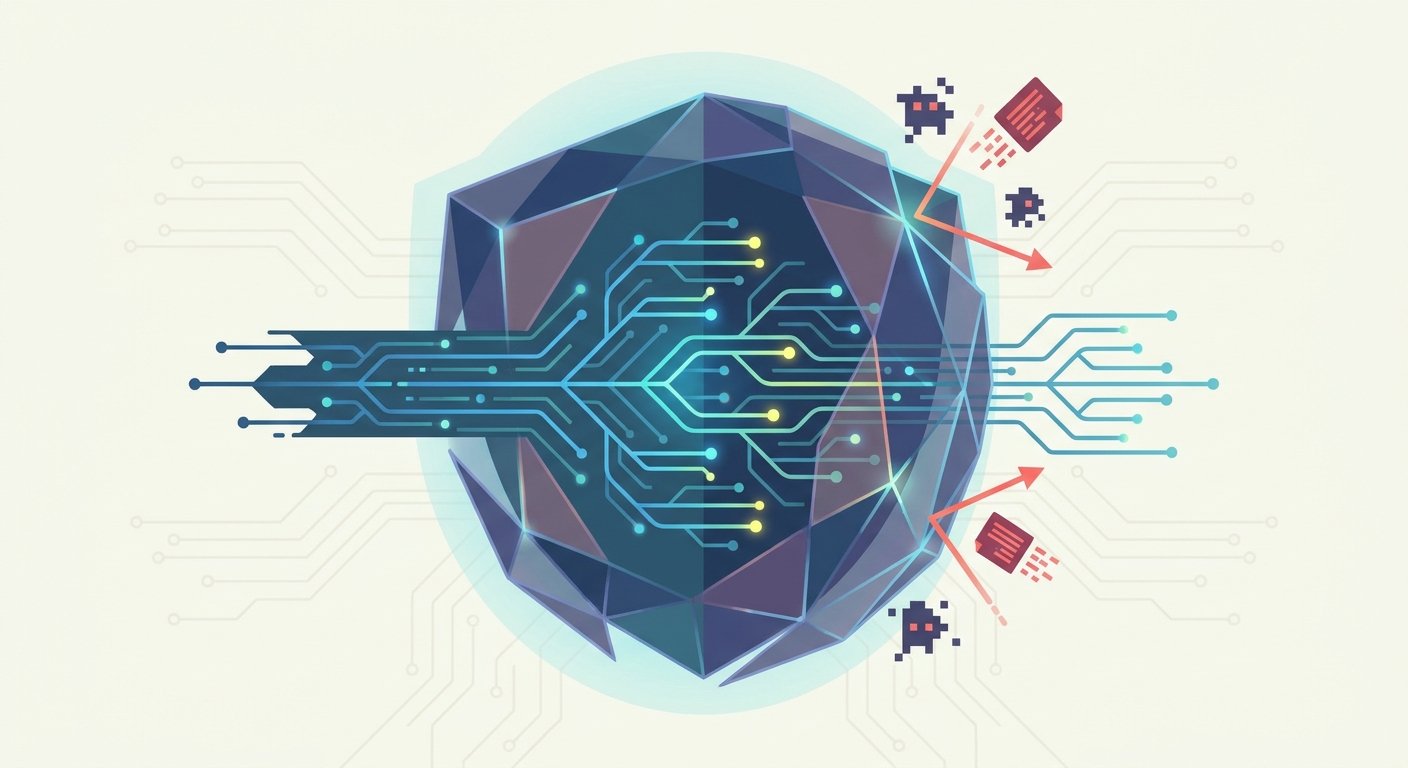
A quantum-hardened pipe is still a pipe. If the data flowing through it is poisoned—via prompt injection or malicious context—the encryption doesn't matter. You’ve just secured the delivery of a malicious payload.
We need a dual-layered strategy. First, harden the transport layer with PQC/Hybrid protocols. Second, implement strict policy-based verification at the Data/Context layer. You can find detailed architectural guidance for this by reviewing the Secure Model Context Protocol Roadmap. This roadmap makes a vital point: in a post-quantum world, "Zero Trust" must apply not just to the user, but to the context being injected into the model itself.
The 2026 Quantum Readiness Checklist
By 2026, the regulatory pressure to prove you are "quantum-safe" will be intense. If you want to stay ahead of the curve, start auditing your infrastructure now. Use this checklist:
- Audit current MCP endpoints: Map every point where your AI agents pull data. Flag every single one that still relies on legacy TLS.
- Identify legacy TLS dependencies: Make sure your load balancers and service meshes are ready to support dual-stack key exchanges.
- Pilot hybrid key encapsulation: Don't wait for a mandate. Run a pilot of ML-KEM on your internal, non-critical AI traffic. See how it handles latency and handshake stability.
- Review your data retention policies: If you aren't using the data, delete it. The best way to stop a "Store Now, Decrypt Later" attack is to ensure there is nothing left to decrypt.
For a deeper dive into these technical requirements, consult our Post-Quantum AI Infrastructure Security Blog, which details the specific configurations for modern enterprise environments.
Is your AI firewall actually useless?
There is a massive, dangerous blind spot in current AI security: the firewall.
Most traditional firewalls inspect traffic by terminating TLS connections, looking at the payload, and then re-encrypting it. When you introduce quantum-resistant encryption, many of these firewalls will effectively go blind. They simply aren't built to process the newer PQC mathematical structures.
If your firewall can't interpret the hybrid handshake, it will do one of two things: it will drop the traffic, breaking your AI agents, or it will bypass inspection entirely, creating a massive, invisible hole in your security perimeter. Before you upgrade your crypto, ensure your inspection points are upgraded to handle the new protocols. A firewall that can't "see" the traffic is just an expensive bottleneck.
Frequently Asked Questions
Does switching to post-quantum cryptography break my existing AI applications?
Not if you use hybrid cryptography. By implementing a dual-layer approach, you maintain backward compatibility with legacy systems while adding a quantum-resistant layer for clients that support it, ensuring no downtime during the transition.
Why should I care about quantum threats today if quantum computers aren't fully mature?
Because of the "Store Now, Decrypt Later" (SNDL) threat. Adversaries are actively harvesting encrypted data today, betting that they will be able to decrypt it in the future. If your data remains sensitive for more than a few years, it is already at risk.
Is TLS 1.3 enough to protect my AI infrastructure?
No. While TLS 1.3 is superior for classical security, it does not inherently protect against quantum-enabled decryption. It must be upgraded or wrapped with post-quantum key encapsulation mechanisms to provide long-term resistance against future-dated decryption.
How does MCP security differ from standard web security?
MCP facilitates dynamic context injection, which creates a unique attack surface. Unlike static web traffic, MCP context can be manipulated to influence an AI model’s behavior (prompt injection). Therefore, you need security that validates the content of the context, not just the integrity of the transport pipe.
What are the 2026 regulatory milestones for quantum-safe AI?
By 2026, many sectors will face requirements to demonstrate that their cryptographic standards meet new NIST-approved post-quantum benchmarks. Enterprise AI infrastructure will likely be audited for "quantum agility" to ensure that systems can be updated without full-scale replacement as standards harden.