Future-Proofing AI: Integrating Post-Quantum Defense into Your Security Stack

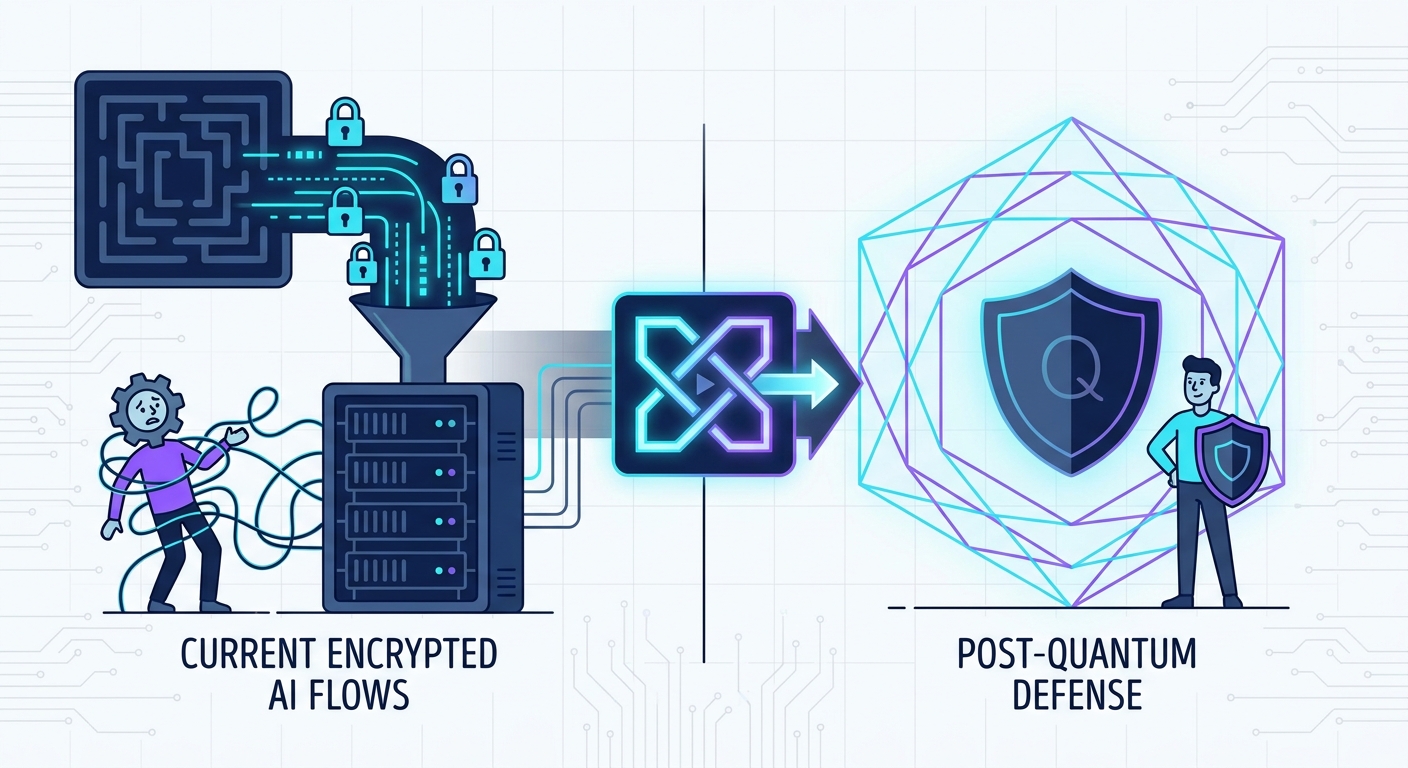
TL;DR
- ✓ Harvest Now Decrypt Later attacks threaten long-term AI data and model weights.
- ✓ Current TLS and RSA encryption standards are vulnerable to future quantum computing decryption.
- ✓ Protecting Model Context Protocol endpoints is critical to securing your distributed AI agent architecture.
- ✓ Transitioning to quantum-resistant infrastructure is an immediate requirement for enterprise data protection.
The "Harvest Now, Decrypt Later" (HNDL) threat isn't some sci-fi nightmare cooked up in an academic basement. It is the operational reality of 2026. State-level actors are currently vacuuming up massive volumes of encrypted traffic, playing a long game. They are betting that within a decade, fault-tolerant quantum hardware will turn our current RSA and ECC standards into digital swiss cheese.
If your AI infrastructure—your models, your training sets, and your agentic reasoning data—is locked behind today’s standard protocols, it is effectively sitting in the open. Transitioning to a quantum-resistant architecture isn’t a "future project" for the next guy to handle. It is an immediate, mission-critical requirement to stop the retroactive theft of your most valuable IP. For those ready to move, our 2026 Roadmap to Post-Quantum AI Infrastructure breaks down exactly how to harden your systems before the door slams shut.
Why Your AI Stack is Already Vulnerable
Let’s be blunt: our digital security is built on math that’s about to hit its expiration date. Modern encryption relies on the difficulty of integer factorization. It’s hard for a classical computer. It’s a cakewalk for a quantum computer running Shor’s algorithm.
For AI, this is particularly nasty. We aren't just talking about a static database. We are talking about the lifeblood of your enterprise: high-dimensional vectors, proprietary model weights, and the training corpora that give you an edge. According to recent Cloud Security Alliance HNDL Research, the danger to AI is acute. Why? Because the data intercepted today—the prompts, the reasoning steps, the fine-tuning data—has a long shelf life. An attacker doesn't need a quantum computer today. They just need patience and a server farm to store your traffic until the tech catches up.
The Model Context Protocol and the New Attack Surface
As we pivot to agentic architectures, the Model Context Protocol documentation has become the gold standard for connecting LLMs to local and remote enterprise tools. While this protocol provides the plumbing to get your AI talking to your data, it also creates a sprawling, distributed attack surface.
Standard Transport Layer Security (TLS) is the internet’s workhorse, but it isn't quantum-safe. When an AI agent hits an MCP endpoint to query a database, it creates a "context window." This is a live stream containing raw requests, internal reasoning, and sensitive retrieved information. If this is intercepted, your proprietary logic is an open book.
The diagram above shows exactly where the status quo fails. That "Context Interception Point" is a vulnerability. By sticking with legacy encryption in an MCP-driven world, you are broadcasting your intellectual property to anyone capable of waiting.
Bridging the Gap with Hybrid Cryptography
You can’t just flip a switch and go post-quantum overnight. It’s too risky. Instead, you need a phased, pragmatic approach: Hybrid Cryptography. The strategy is simple: wrap your existing classical infrastructure with NIST Post-Quantum Cryptography Standardization approved lattice-based algorithms, like CRYSTALS-Kyber for key encapsulation and CRYSTALS-Dilithium for digital signatures.
Why go hybrid? It’s a safety net. If a flaw is found in a new PQC algorithm, your classical layer still holds the fort. If a quantum computer comes online, the PQC layer takes the lead. This keeps you compliant with standards without breaking legacy systems that can’t handle the heftier key sizes of post-quantum tech.
A Four-Phase Migration Path
Moving to a quantum-resilient state takes discipline. We recommend a four-phase framework to keep your stack agile while you harden it.
Phase 1: Assessment. You can’t protect what you haven't mapped. Audit every AI-to-tool data flow, especially those using the Model Context Protocol.
Phase 2: Cryptographic Agility. This is the big one. Stop hard-coding your encryption. If your system is locked to RSA-2048, you are trapped. Build an abstraction layer so you can swap out cryptographic providers as standards evolve.
Phase 3: Hybrid Implementation. This is where the rubber meets the road. Implementing Quantum-Resistant Encryption for MCP secures the specific channels carrying your most sensitive reasoning data.
Phase 4: Monitoring. In a quantum-safe world, you aren't just watching traffic volume—you're watching the integrity of your key management. Keep an eye out for anomalies in latency or authentication failures; they’re often the tell-tale sign of someone probing your new defenses.
Securing the Agentic Future: Keys and Integrity
Distribution is the headache of the agentic era. Unlike a static web server, AI agents are ephemeral—they spin up and down in milliseconds. Managing PQC keys here requires moving away from the old "set it and forget it" certificate cycles.
Traditional 90-day rotation cycles don't cut it anymore. PQC keys are big, complex, and require automated management that doesn't choke your performance. But don't forget the agent itself. If an attacker injects a prompt that compromises your MCP host, quantum-resistant encryption on the wire won't save you if the agent's brain has been subverted.
The Business Cost of Inaction
It’s tempting to treat quantum threats as a "tomorrow" problem. That’s a strategic gamble you’ll likely lose. Losing your proprietary model weights isn't just a breach; it’s a permanent loss of your competitive advantage.
Look at the regulatory trajectory. Governments are already telegraphing that post-quantum compliance will be mandatory for critical infrastructure. If you wait for the mandate, you will be scrambling to retrofit a system that was never built for agility. Proactive migration is a rounding error compared to the cost of an emergency, forced migration—or worse, a public breach.
Moving From "Quantum-Ready" to "Quantum-Resilient"
Transitioning to a quantum-resilient stack isn't about perfection on day one. It’s about building the muscle to adapt. By adopting hybrid cryptography, mapping your MCP flows, and ensuring cryptographic agility, you are future-proofing your business against the biggest cryptographic shift of the century.
The tools are ready. The standards are maturing. The risks are clear. The only thing left to decide is when you start. Audit your MCP deployments today, identify your high-value channels, and get moving. The quantum clock is ticking. Don't let your infrastructure be the one caught in the net.
Frequently Asked Questions
Is my AI infrastructure really at risk from quantum computers today?
Yes. Through "Harvest Now, Decrypt Later" (HNDL) attacks, adversaries are capturing encrypted traffic today. Even if they cannot decrypt it now, they store that data to decrypt it once fault-tolerant quantum hardware becomes available.
What makes the Model Context Protocol (MCP) a special target for quantum threats?
MCP facilitates the exchange of "context"—the reasoning, prompts, and tool-access data—that defines how an AI agent operates. If this context is intercepted and later decrypted, an attacker gains visibility into your proprietary AI logic and sensitive enterprise data flows.
Do I need to replace my entire security stack to be quantum-resistant?
No. You do not need a "rip and replace." The industry standard is a hybrid cryptographic approach, which allows you to wrap existing classical infrastructure with NIST-approved PQC algorithms, providing a secure bridge until full migration is achieved.
How do I start the transition to a hybrid cryptographic stack?
Start by identifying which data flows are most sensitive (e.g., those involving MCP) and begin testing NIST-standardized algorithms like CRYSTALS-Kyber for key exchange in those specific channels before rolling it out across your broader infrastructure.