Quantum Cyber: The Next Frontier in Enterprise AI Infrastructure Security

TL;DR
- ✓ State-sponsored hackers use HNDL tactics to steal your long-term enterprise AI data.
- ✓ Traditional encryption standards like RSA will fail against future fault-tolerant quantum computers.
- ✓ Model Context Protocol creates new vulnerabilities that require robust, quantum-resistant security architectures.
- ✓ Organizations must shift to a data-level Zero Trust model to protect proprietary AI assets.
Forget the sci-fi talk about quantum computers being a "future" problem. That ship has sailed. In 2026, the threat isn't some abstract math equation—it’s a cold, hard operational reality called "Harvest Now, Decrypt Later" (HNDL).
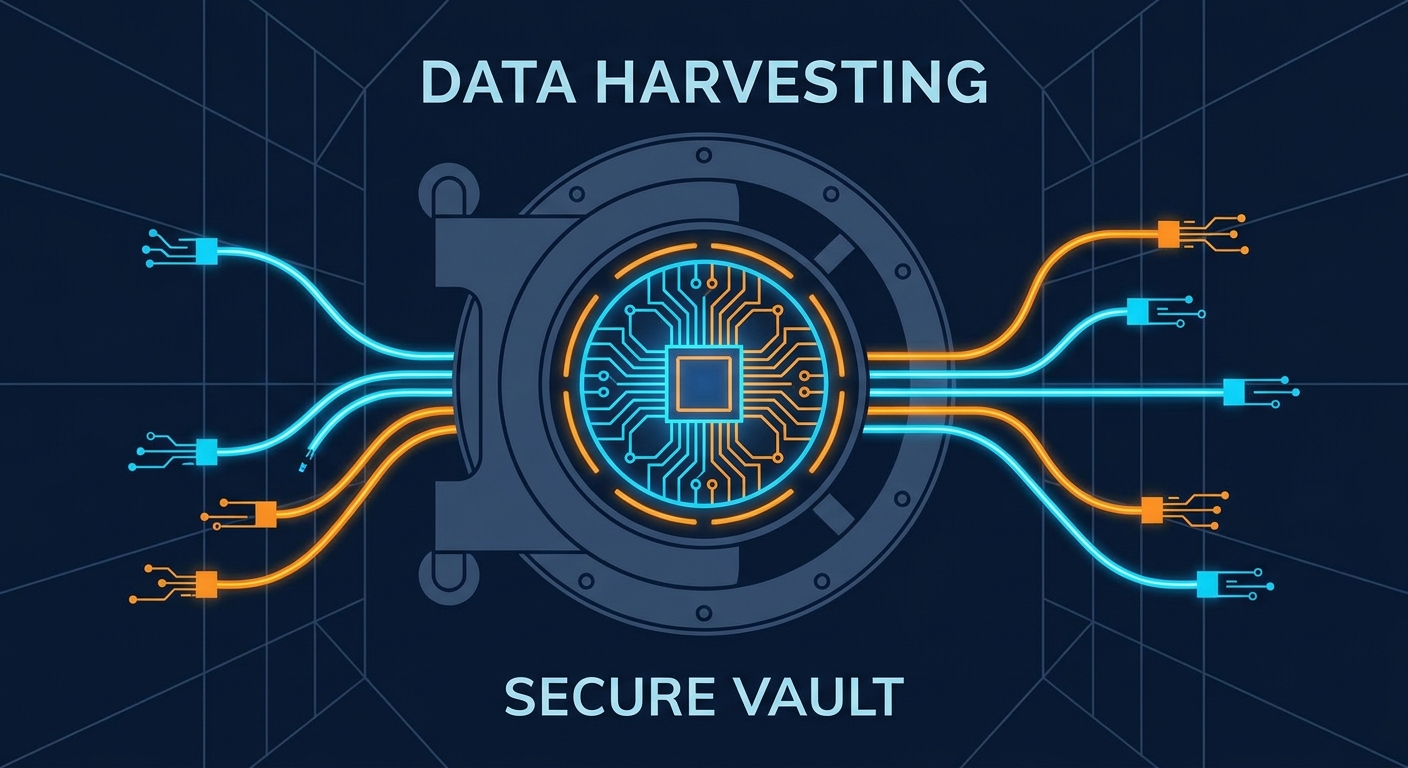
State-sponsored hackers and organized cyber-syndicates aren't waiting for the perfect quantum machine to go live. They’re busy right now. They are scraping massive amounts of your encrypted AI training data, model weights, and internal logs. They’re hoarding this data in digital vaults, waiting for the day they can flip the switch and decrypt it all at once.
If you want to stay in business, your security strategy needs a radical overhaul. You have to move to a "Data-Level Zero Trust" model. Stop assuming your network is safe. Stop assuming your transport layers are secure. From here on out, the only thing that matters is the cryptographic integrity of the data itself. If it isn't locked down, it’s already gone.
The HNDL Threat: Why Your AI is Already Being Stolen
The "Harvest Now, Decrypt Later" strategy is essentially a silent auction of your company’s future.
Think about it: traditional encryption standards like RSA and ECC are fine for your average web traffic today. But they’re sitting ducks for Shor’s algorithm. Once a fault-tolerant quantum computer comes online, these standards will crumble like a house of cards.
Because AI models rely on long-term data retention—the training sets that define your intellectual property for years—the risk is hyper-concentrated. According to Cloud Security Alliance research on the quantum risk to AI infrastructure, the primary objective of modern adversaries is to intercept and catalog high-value model weights today. They are ensuring they hold the keys to your future innovation the second quantum decryption becomes trivial.
If you’re still treating your AI infrastructure as a static perimeter, you’re chasing ghosts. Your proprietary algorithms are the crown jewels. Every time these models fire data across standard TLS-encrypted channels, you’re broadcasting your secrets to an audience that’s playing the long game.
The Model Context Protocol: An Unintended Backdoor
Modern AI is complex, and that complexity is exactly where your security is failing. The Model Context Protocol (MCP) has become the industry darling for connecting AI agents to enterprise data stores, documentation, and internal tools. It’s fluid. It’s fast. It’s also a massive target.
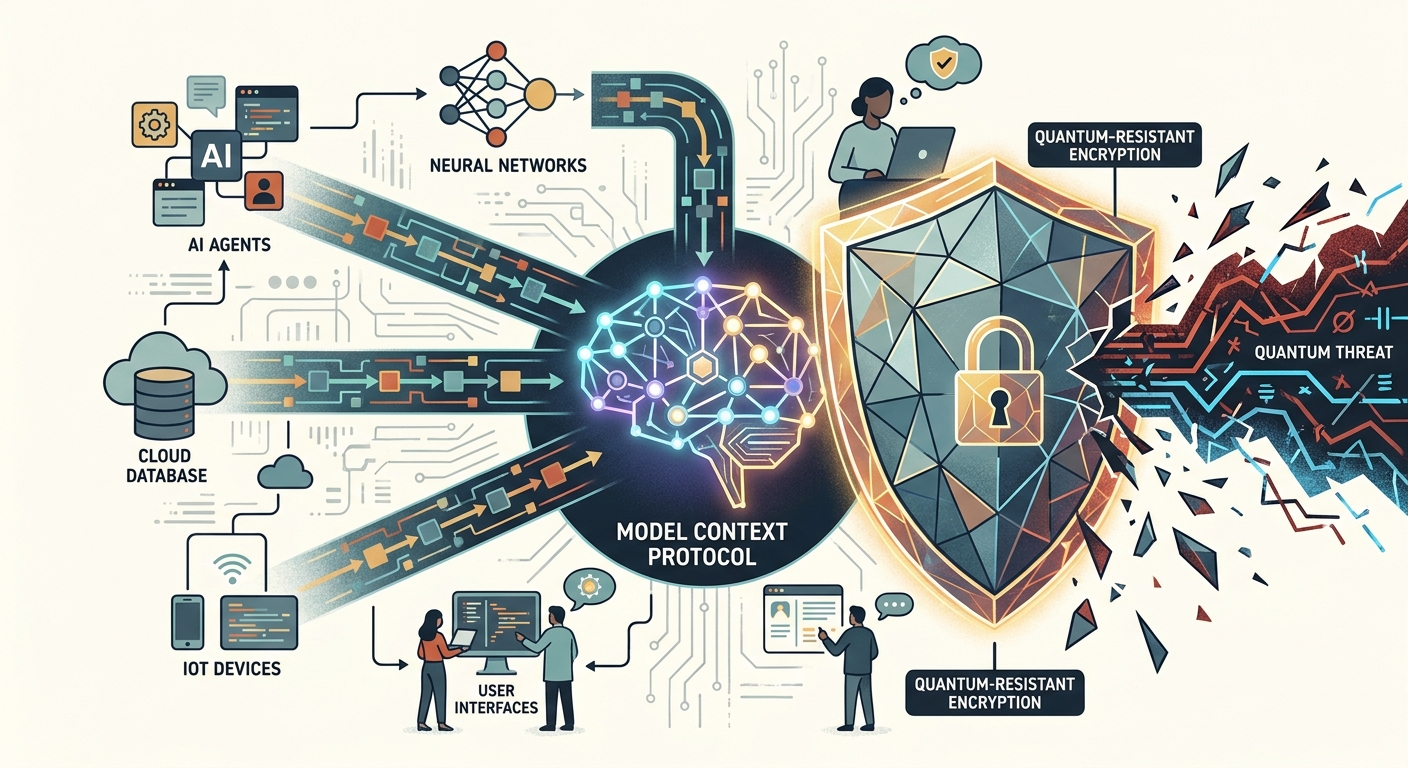
The protocol’s reliance on stdio for command execution creates a direct bridge between your AI agents and your internal infrastructure. In a world of quantum-speed automated vulnerability discovery, an attacker doesn’t need to spend months manually probing your systems. They can use quantum-accelerated scripts to sniff out weaknesses in the MCP bridge, executing shell commands or traversing internal directories before your security team even knows someone is at the door.
This flow shows just how fragile these agentic workflows are. By compromising the protocol bridge, an attacker gains lateral access to your most sensitive systems. The AI agent, meant to be your biggest productivity booster, effectively becomes a Trojan Horse if the transport layer and the protocol handling it aren’t explicitly hardened.
Building a Quantum-Resistant AI Infrastructure
You have to abandon the "perimeter-first" mentality. It’s dead. The only way forward is a hybrid cryptographic approach. By pairing NIST-standardized Post-Quantum Cryptography (PQC) with classical encryption, you protect yourself against today’s threats while hardening your defenses for the quantum-enabled adversaries of tomorrow.
This isn’t just a software update. It’s a total shift in mindset. You need a Post-Quantum AI Infrastructure Security Framework that treats every single packet of data as a potential target. Shift your security from the network edge to the data packet itself. When an AI agent reaches into a repository, that transaction must be signed and encrypted with PQC-ready modules. Even if the network is tapped, the payload remains computationally opaque to a quantum computer.
The Migration Path for Sovereign AI Compliance
Procurement standards for AI—like those coming out of FedRAMP and NATO—are evolving fast. Quantum-resistant infrastructure is no longer a "nice-to-have"; it’s becoming a non-negotiable requirement. If you aren’t compliant, you’re going to be locked out of government and defense contracts. Period.
For security architects, the path forward is a simple, three-part mandate:
- Inventory of AI Data Pipelines: You can't protect what you can't see. Map out every point where your AI models ingest, process, or output data.
- Audit of MCP Integrations: Treat every MCP connection as a high-risk vector. Examine the permissions granted to these agents. Ensure that
stdiocommunication is monitored for anything that looks even slightly suspicious. - Integration of Hybrid PQC Modules: Start rolling out quantum-resistant identity and access management. For a deeper dive into this process, review our guide on Post-Quantum Identity & Access Management for AI Agents.
Neutralizing Quantum-Speed Threats in Real-Time
If the attack is automated and quantum-accelerated, your defense better be autonomous and AI-driven. Humans are too slow. If you’re relying on a manual response to a breach happening at machine speed, you’ve already lost.
Modern security infrastructure needs intelligent access control that analyzes protocol behavior in real-time. Watch the specific interactions between your AI agents and your data sources. You can spot the early signs of command injection or unauthorized lateral movement if you’re looking for them.
The system needs to understand the "intent" of an AI agent. If an agent suddenly tries to access a database or run a command that falls outside its normal baseline, quarantine it. Immediately. For those ready to start, our 2026 AI Security Best Practices Checklist provides a granular roadmap for achieving this level of operational readiness.
The Path Forward
Quantum cyber isn’t some academic debate for ivory tower researchers. It is the defining security challenge of the next decade. The organizations that win in this era of AI will be the ones that view security as a living, breathing architecture—one that assumes the worst and prepares for the inevitable.
Audit your MCP deployments today. Shift your data pipelines toward PQC-readiness. The speed of attack is only going one way: up. Your ability to secure the future of your AI infrastructure depends entirely on the actions you take before the quantum threshold is crossed. Don't wait for your competition to do it for you.
Frequently Asked Questions
Are AI models currently at risk from quantum computers?
Yes, specifically through "Harvest Now, Decrypt Later" (HNDL) attacks. While a fully fault-tolerant quantum computer may be years away, sensitive AI training data and model weights intercepted today are being stored by adversaries for decryption as soon as the technology matures.
What makes the Model Context Protocol (MCP) uniquely vulnerable?
MCP facilitates communication between AI models and external data/tools via stdio, creating a direct bridge into your infrastructure. If not properly secured, this bridge can be exploited for unauthorized command injection, allowing attackers to manipulate or extract data directly from your AI agents.
How do we start implementing post-quantum security in 2026?
Enterprises should immediately begin auditing their data pipelines for PQC readiness. The first step is to implement hybrid cryptography—combining classical and quantum-resistant algorithms—on all AI agent-to-environment connections to ensure both current and future data integrity.
What is the difference between classical and post-quantum encryption in an AI context?
Classical encryption (like RSA) relies on mathematical problems that quantum computers can solve rapidly. Post-Quantum Cryptography (PQC) uses complex lattice-based mathematical structures that are resistant to quantum-speed decryption, ensuring that your AI infrastructure remains secure even in a post-quantum landscape.