Implementing Quantum-Resistant Encryption in Model Context Protocol (MCP) Systems

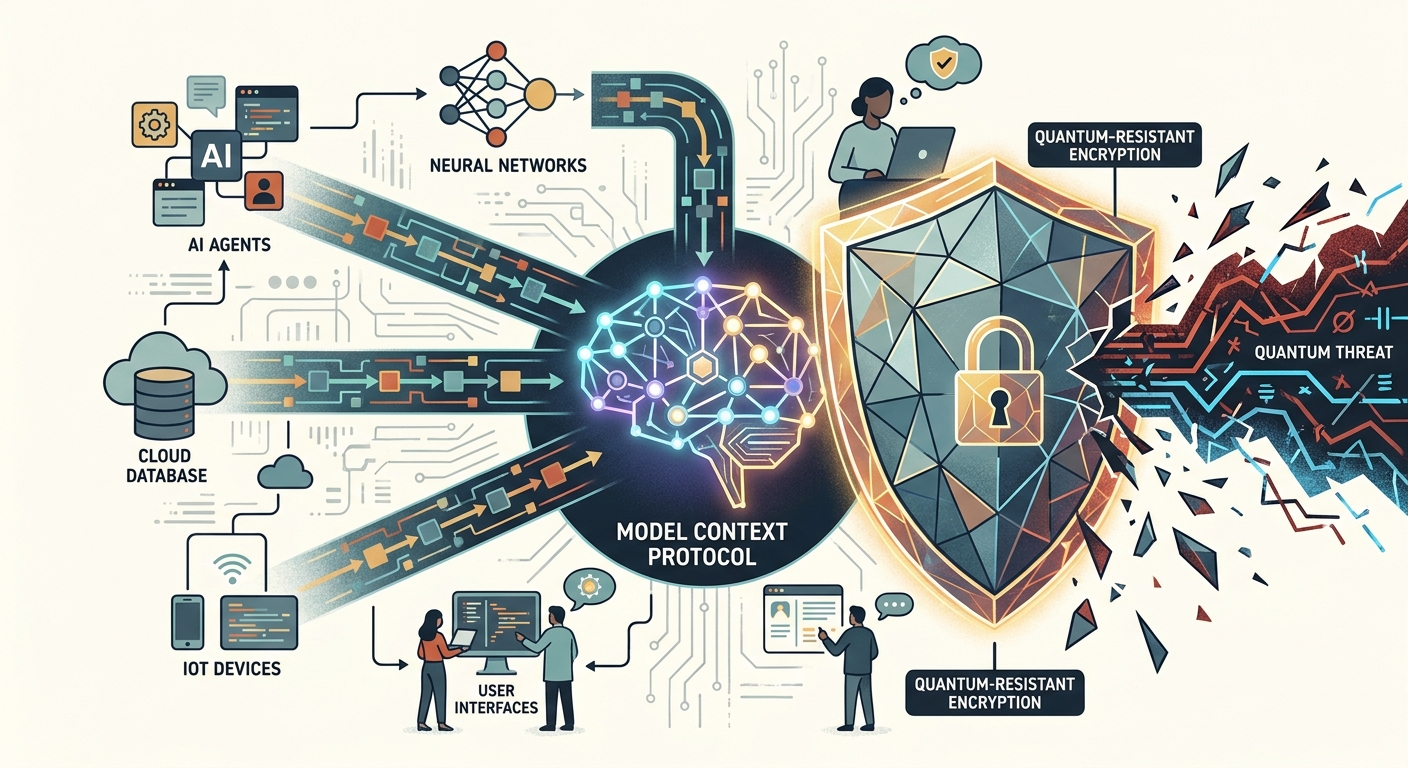
TL;DR
- ✓ MCP systems face critical vulnerabilities from future quantum computing decryption threats.
- ✓ Harvest Now Decrypt Later attacks currently archive your sensitive AI agent traffic.
- ✓ Traditional TLS encryption is insufficient against upcoming cryptographically relevant quantum computers.
- ✓ Organizations must upgrade to quantum-resistant standards to secure agentic infrastructure today.
The Model Context Protocol (MCP) is the glue holding the modern AI stack together. It’s how your agents talk to your databases, your internal tools, and your messy enterprise data. It’s fast, it’s convenient, and it’s arguably the most important piece of plumbing in your software architecture.
But there’s a massive hole in the floorboards.
While your agents are busy automating workflows and fetching sensitive data, they’re traveling through tunnels that rely on a very specific, very fragile assumption: that factoring large prime numbers is impossible. That assumption is about to expire. The moment a Cryptographically Relevant Quantum Computer (CRQC) comes online, that "unbreakable" encryption becomes a sieve.
Quantum-readiness isn’t a hobby for academics in 2030. If you’re running agentic infrastructure today, you have a deployment deadline of 2026.
The Ticking Clock in Your Server Room
The speed of MCP adoption has been nothing short of wild. But this rapid-fire integration has created a new, dangerous form of "Shadow IT." Because MCP allows agents to hop over traditional network boundaries to grab context or fire off commands, it’s creating invisible attack surfaces that your standard security tools don't even know how to look for.
The biggest danger? We treat MCP traffic as "internal" and "trusted" by default. When an agent hits an MCP server, the protocol opens the floodgates for high-privilege information. If someone intercepts that flow, they aren't just grabbing a few packets. They’re hijacking the agent's intent. By ignoring the long-term integrity of these connections, we’re essentially building our AI future on a foundation of shifting sand.
Why MCP is a Prime Target for "Harvest Now, Decrypt Later"
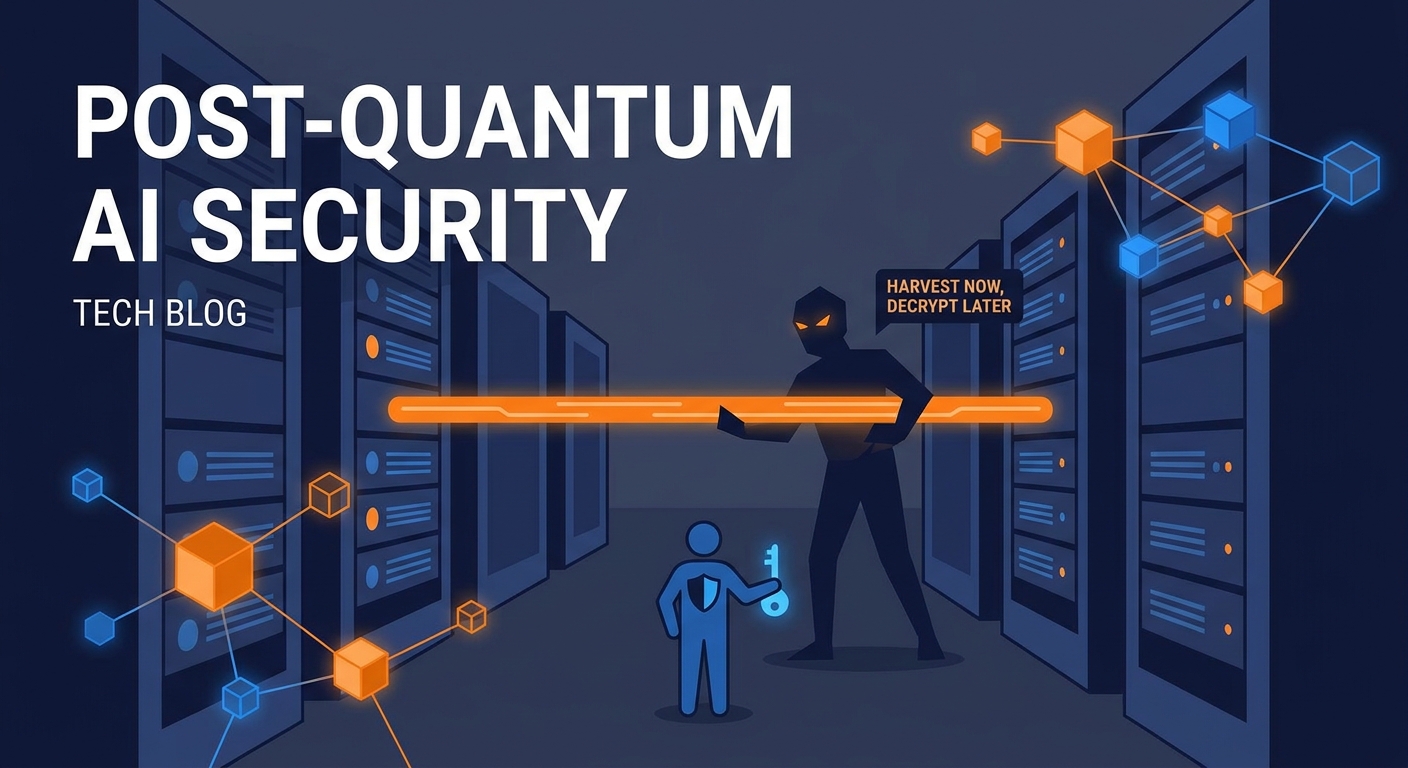
If you’re a CISO, your nightmare isn't just a live breach—it’s the "Harvest Now, Decrypt Later" (HNDL) model. As noted in the Cloud Security Alliance analysis on AI infrastructure, bad actors are currently vacuuming up massive amounts of encrypted traffic. They don't care that they can't read it today. They’re storing it, waiting for the day a CRQC arrives to crack the RSA and ECC keys.
The visibility gap here is massive. Your current monitoring tools look for signature-based threats or weird traffic spikes. They aren't programmed to flag the underlying math as a liability. Because MCP traffic usually tunnels through standard TLS, your team assumes it’s safe. It’s not. Every instruction, every API key, and every scrap of sensitive context transmitted today is currently being archived by adversaries. Once the quantum threshold is crossed, the vault doors will swing open.
How the MCP Architecture Interacts with Quantum Threats
To understand where the risk lives, you have to look at the split between the transport layer and the action layer within the MCP framework.
The diagram above shows the dual-threat nature of the beast. Your Transport Tunnel (TLS) is the primary target for HNDL. But look at the Action Layer—where the agent explicitly triggers a tool. If that message isn't cryptographically verified, an attacker can inject commands or tamper with the execution flow.
The "Hybrid Approach": The Industry Standard
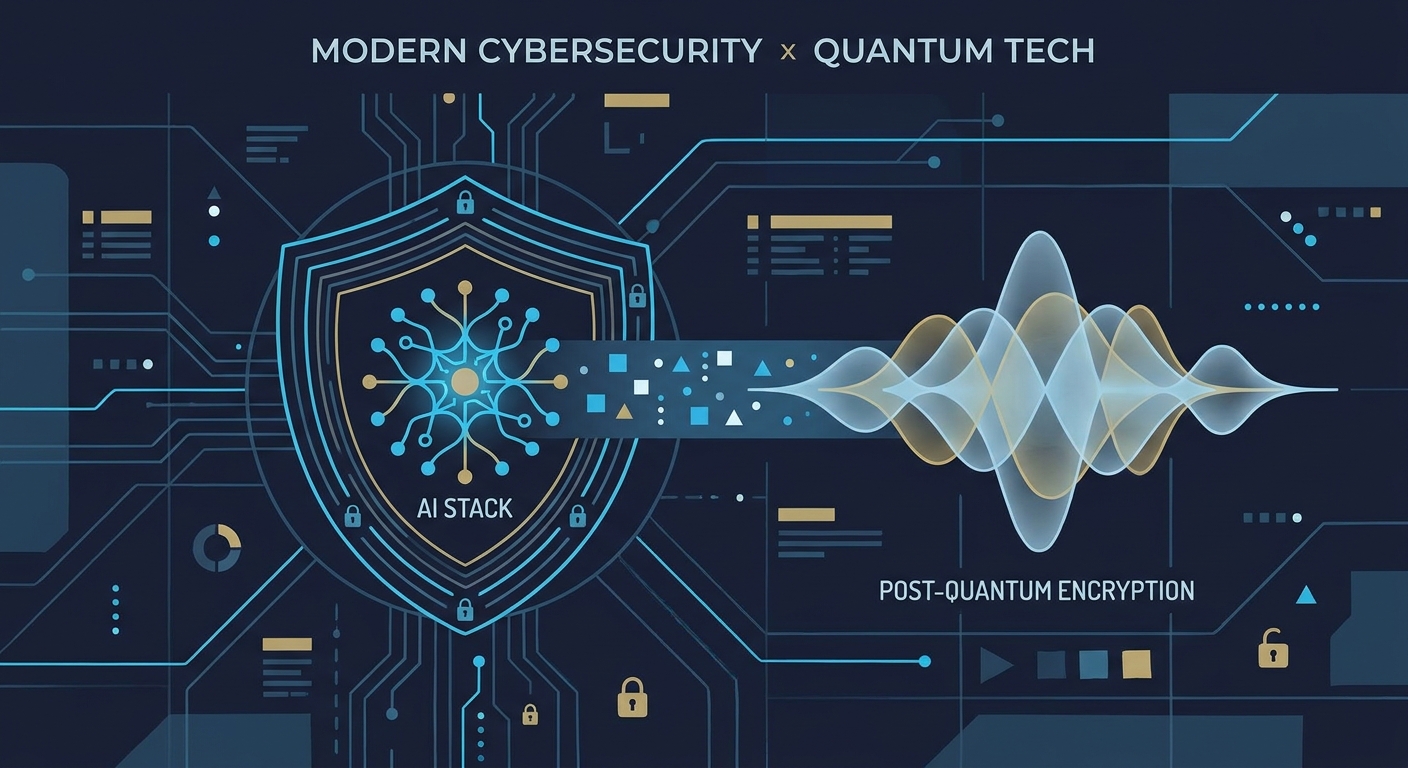
We can't just throw out RSA and ECC overnight. The world would stop turning. The industry-recognized fix is the "Hybrid Approach." By wrapping your existing classical encryption in a post-quantum layer, you create a "belt and suspenders" scenario. As long as one of the two algorithms holds up, your connection stays safe.
This strategy is built on the NIST Post-Quantum Cryptography standards. NIST has moved past the whiteboard stage, providing battle-tested algorithms that let developers layer in quantum-resistant security without breaking compatibility with older clients.
Building a Quantum-Resistant MCP Pipeline
Securing your pipeline requires a two-pronged attack: upgrading the transport layer and locking down message integrity at the action layer.
Step 1: Upgrading the Transport Layer
The easiest way to kill the transport vulnerability is a hybrid TLS handshake. By combining X25519 (classical) with Kyber (quantum-resistant), you force an attacker to break both a standard elliptic curve and a lattice-based PQC algorithm at the same time. It’s a massive leap in difficulty.
Step 2: Securing the Action Layer
Transport security is useless if the agent is being fed malicious instructions. You need message-level integrity via CRYSTALS-Dilithium digital signatures. This ensures that every tool call or function invocation is cryptographically signed by an authorized agent. Even if someone pierces the tunnel, they can't execute unauthorized code. For a deep dive into the code-level implementation, check out our technical implementation guide for protecting MCP with quantum-proof encryption.
Auditing Your MCP Endpoints
Most engineering teams have the same problem: they don't know what they don't know. You can't secure what you can't see. Your first move is to map every active AI agent and their access permissions.
Start framing PQC implementation as part of your compliance posture. SOC2 and other frameworks are already starting to sniff around for quantum-readiness. If you get ahead of this now, you’ll save yourself a massive headache later. For those looking to get started, our 2026 AI Security Checklist provides a roadmap for assessing your current MCP landscape.
Comparative Analysis: Traditional vs. Quantum-Safe MCP
| Feature | Traditional MCP (TLS 1.3) | Quantum-Safe MCP (Hybrid) |
|---|---|---|
| Key Exchange | RSA/ECC (Vulnerable) | Kyber (PQC) + ECC (Classical) |
| Integrity | HMAC/Digital Signatures | CRYSTALS-Dilithium |
| HNDL Resilience | None | High |
| Performance | Baseline | Negligible Latency Increase |
For a comprehensive view on how these standards interact with the core protocol, refer to the Model Context Protocol Specification.
2026 Readiness Checklist for Engineering Teams
- Inventory Audit: Identify every single agent-to-server connection using the MCP specification.
- TLS Assessment: Check if your current TLS libraries support hybrid key exchange modes.
- Action Layer Signing: Look into implementing Dilithium signatures for high-privilege agent functions.
- Prioritization: Start with agents that have access to PII, CI/CD pipelines, or admin credentials.
- Vendor Review: Grill your third-party vendors—if they aren't on a roadmap for PQC, they're a liability.
Frequently Asked Questions
Does my current TLS 1.3 encryption protect me from quantum attacks?
No. While TLS 1.3 is secure against classical threats, it remains vulnerable to future decryption by quantum computers if it relies on standard RSA or ECC key exchanges.
What is the most immediate step to secure MCP deployments?
The most immediate step is to implement hybrid key encapsulation (combining classical algorithms with quantum-resistant ones) to secure the transport tunnel while maintaining backward compatibility.
Is it enough to just encrypt the data in transit?
No. Because MCP allows agents to execute functions and access enterprise data, you must also implement cryptographic signatures (using algorithms like CRYSTALS-Dilithium) to verify the integrity and origin of every instruction.
How does PQC affect the latency of my AI agents?
The computational overhead introduced by Kyber and Dilithium is minimal. In the context of an AI agent, where the primary latency bottleneck is model inference time, the security-related overhead is typically negligible and rarely perceptible to the end user.