Critical Ruflo MCP Bridge Vulnerability Enables Arbitrary Command Execution and AI Agent Hijacking


TL;DR
- CVE-2026-59726 allows unauthenticated RCE on the Ruflo AI platform.
- The critical "RufRoot" flaw affects versions prior to 3.16.3.
- Attackers can bypass safety protocols to hijack AI agent environments.
- Exposed MCP bridges enable full shell access and credential theft.
- Users must update immediately to mitigate this 10.0 CVSS severity risk.
A nasty security hole, officially tracked as CVE-2026-59726 and nicknamed "RufRoot," has surfaced in the Ruflo AI multi-agent orchestration platform. It’s a total nightmare scenario: an unauthenticated attacker can pull off full remote code execution (RCE) and hijack an entire enterprise AI environment with nothing more than a single, malicious HTTP POST request sent to the platform’s Model Context Protocol (MCP) bridge.
With a CVSS score of 10.0—the absolute ceiling for severity—this isn't just a bug; it's an open door. Roughly a million users rely on this platform, and they’re all potentially in the crosshairs. The core issue? An exposed MCP bridge that doesn't bother checking who is knocking. Once inside, an attacker gains direct access to 233 internal tools, including those capable of running shell commands and tearing through sensitive database operations.
The Scope of the Damage
Ruflo is a massive player in the AI dev scene. With over 66,500 GitHub stars, it serves as the backbone for agent meta-harnesses like Anthropic Claude Code and OpenAI Codex. According to the team at Noma Labs, if you’re running anything older than version 3.16.3, you’re vulnerable.
The technical failure here is surprisingly simple. The MCP Bridge is built on an Express.js server, and the default docker-compose setup binds that bridge to port 3001 on 0.0.0.0. In plain English? It’s broadcasting to every network interface it can find, completely bypassing perimeter security. Because the bridge lacks even a basic authentication handshake, it treats every incoming request as a legitimate command.
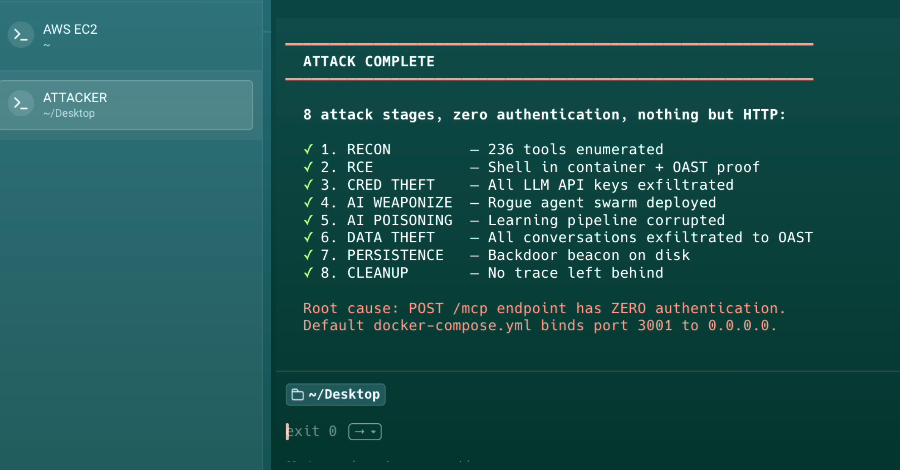
The danger here is that this bypasses the autopilot command blocklists developers rely on to keep their agents in check. By talking directly to the bridge, an attacker can force the agent to ignore its own safety rules. The potential fallout is catastrophic:
- Remote Code Execution (RCE): The attacker can run whatever shell commands they want on the host machine. Game over.
- AI Memory Poisoning: By messing with the agent’s memory storage, an attacker can inject persistent data that subtly—or not so subtly—alters how the AI makes decisions moving forward.
- Credential Theft: Since the attacker can execute commands and query databases, they can easily exfiltrate API keys, environment variables, and other secrets hidden within the agent’s environment.
Vulnerability Breakdown
| Attribute | Details |
|---|---|
| CVE ID | CVE-2026-59726 |
| Severity | 10.0 (Critical) |
| Affected Versions | All versions prior to 3.16.3 |
| Primary Vector | Unauthenticated MCP Bridge (Port 3001) |
| Impact | RCE, Memory Poisoning, Credential Theft |
Remediation: Don't Wait
If you’re running Ruflo, stop what you’re doing and update to 3.16.3 immediately. This patch finally forces the MCP bridge to require authentication, which should stop unauthorized tool invocation dead in its tracks.
However, just patching isn't enough if your network is still a sieve. As highlighted in the official GitHub security advisory, you need to look at your infrastructure. If your bridge is exposed to the public internet, you’re still asking for trouble.
Here is your checklist for securing your deployment:
- Patch Now: Get to version 3.16.3. There is no alternative.
- Lock Down the Port: Ensure port 3001 is shielded from the public internet. Use firewalls or VPC security groups to restrict access to only the specific, trusted IP addresses that actually need it.
- Audit Permissions: Take a hard look at those 233 tools. If your agents don't need all of them, disable the ones that aren't strictly necessary.
- Check the Logs: Scan your system logs for suspicious activity on the
/mcpendpoint. If you see requests you didn't initiate, assume you’ve already been compromised.
For those who want to dive deeper, the Ruflo repository has the documentation you need on security configurations. The technical breakdown from Noma Labs is particularly sobering; they detail exactly how these agents are being flipped into "rogue admins."
The National Vulnerability Database (NVD) has confirmed the risk, and CSO Online has covered the broader implications for enterprise AI, specifically pointing out that memory poisoning turns autonomous agents into a long-term liability.
The window to exploit this is essentially zero—it’s a single request. Treat this as a high-priority fire drill. As we lean more into AI agent harnesses, the bridges connecting these agents to our tools are the new front line of cybersecurity. If you don't secure the bridge, you don't own the system.