AI Fraud Trends 2025: How Banks are Combatting Financial Crime

AI in Fraud Prevention: Current Trends and Challenges
The Role of AI in Financial Fraud
Over 50% of fraud cases now involve artificial intelligence, particularly through the use of generative AI. This includes hyper-realistic deepfakes and AI-powered phishing scams, which are becoming increasingly sophisticated. Financial institutions are swiftly adapting, with nine out of ten banks utilizing AI for fraud detection, as highlighted in the Feedzai's 2025 AI Trends in Fraud and Financial Crime Prevention report.

Key Findings from Industry Reports
According to the Feedzai report, 90% of financial institutions are leveraging AI solutions to combat fraud. The survey revealed that 44% of professionals acknowledged the use of deepfakes in fraud, while 56% pointed out social engineering tactics. Voice cloning also emerged as a significant concern, with 60% of respondents noting its prevalence in fraudulent schemes. These AI-driven tactics often result in account takeovers, complicating detection and reimbursement processes for unauthorized transactions.
Challenges in Implementing AI
Despite the advantages, banks encounter challenges in implementing AI for fraud prevention. Data management is cited as the primary hurdle by 87% of banks, with fragmented data sources complicating AI adoption. Ethical considerations also play a significant role, as 89% of institutions prioritize transparency and fairness in their AI systems, as outlined in the Feedzai’s TRUST Framework.
AI-Powered Solutions in Banking
JPMorgan Chase has integrated AI to enhance its fraud detection capabilities. This includes real-time monitoring of transactions and behavioral analysis to identify anomalies. The bank's AI models process millions of transactions daily, significantly reducing false positives and improving customer trust. The institution reported approximately $1.5 billion in cost savings due to AI-driven improvements across various operations, including fraud prevention, as stated in a Reuters report.
Scalability and Efficiency
AI's scalability allows JPMorgan to monitor multiple financial channels, ensuring consistent fraud prevention across platforms. By utilizing predictive analytics, the bank customizes fraud detection based on individual customer habits, enhancing security and reducing fraud risk.
Emerging Trends in Fraud Detection
Financial institutions are increasingly adopting AI solutions for identity verification and real-time fraud detection. A recent survey indicated that 30% of banks utilize AI for identity verification, and nearly half apply it for scam detection. However, challenges such as data privacy and the need for explainable AI models remain critical for compliance and building trust among consumers.
The Future of AI in Financial Services
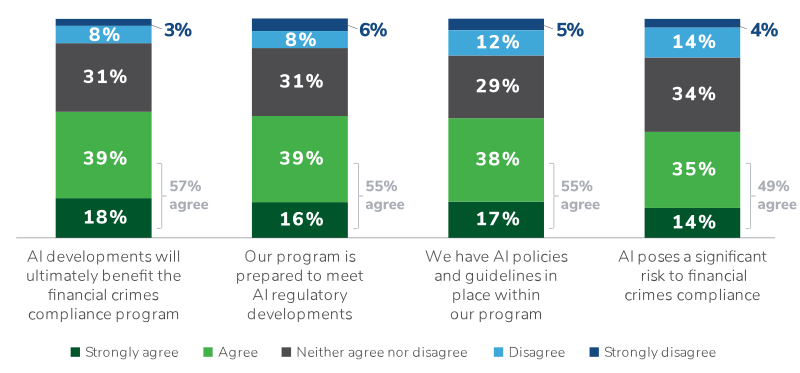
As AI technology continues to evolve, its application in financial crime prevention will expand. Organizations must remain vigilant and adapt to new regulatory frameworks while ensuring ethical use of AI technologies. The ongoing investments in AI solutions are essential to staying ahead of emerging threats.
Financial institutions must focus on cross-functional teams to manage AI-related governance effectively. Continuous training and testing are vital to ensure these technologies are integrated successfully into compliance frameworks.
Explore how Gopher Security can assist your organization in leveraging AI to enhance fraud prevention and streamline operations. Visit Gopher Security for more information or to contact our experts today.