Defending Against AI Cybersecurity Threats: A Guide to Quantum-Proof Infrastructure

TL;DR
- AI infrastructure faces imminent threats from quantum-enabled data harvesting.
- Adopt quantum-resistant algorithms to combat 'Store Now, Decrypt Later' (SNDL) attacks.
- Traditional perimeter security is obsolete; shift to identity-centric orchestration.
- Protect model weights and training sets as high-value enterprise assets.
- Secure Model Context Protocol (MCP) deployments against new, high-friction attack vectors.
We’ve hit a weird, dangerous intersection. On one side, AI models are scaling at a pace that feels almost reckless. On the other, the shadow of cryptographically relevant quantum computers is finally stretching across the horizon. The result? Our most advanced AI infrastructure is currently built on a foundation of sand.
Companies are rushing to plug autonomous agents into everything, but they’re doing it with one eye closed. They’re leaving doors wide open to a new class of threats that don’t care about breaking in today—they care about harvesting your data for a rainy day years from now. If you want to defend your AI infrastructure in 2026, you have to stop obsessing over firewalls and perimeter security. It’s time for cryptographic agility and identity-centric orchestration. You need to protect your model weights and training sets against both the exploits of today and the quantum nightmares of tomorrow.
Why the AI-Quantum Crisis is Already Here
Look at the sheer scale of modern AI. We’re dealing with massive model weights and training datasets that are, quite literally, the "crown jewels" of the modern enterprise. We used to protect these assets by building a digital fortress—firewalls, VPNs, the works. But that model is dead. As AI agents bounce between distributed cloud environments and third-party APIs, the "perimeter" has essentially evaporated.
We’re in an era where data-in-transit is your biggest liability. If your traffic isn’t wrapped in quantum-resistant standards, you’re just handing your IP to anyone with a storage drive and a long-term plan. The CISA Quantum Readiness guidance isn’t some "future-proofing" hobby project. It’s a survival requirement. If your data needs to stay secret for more than a few years, you need to act now.
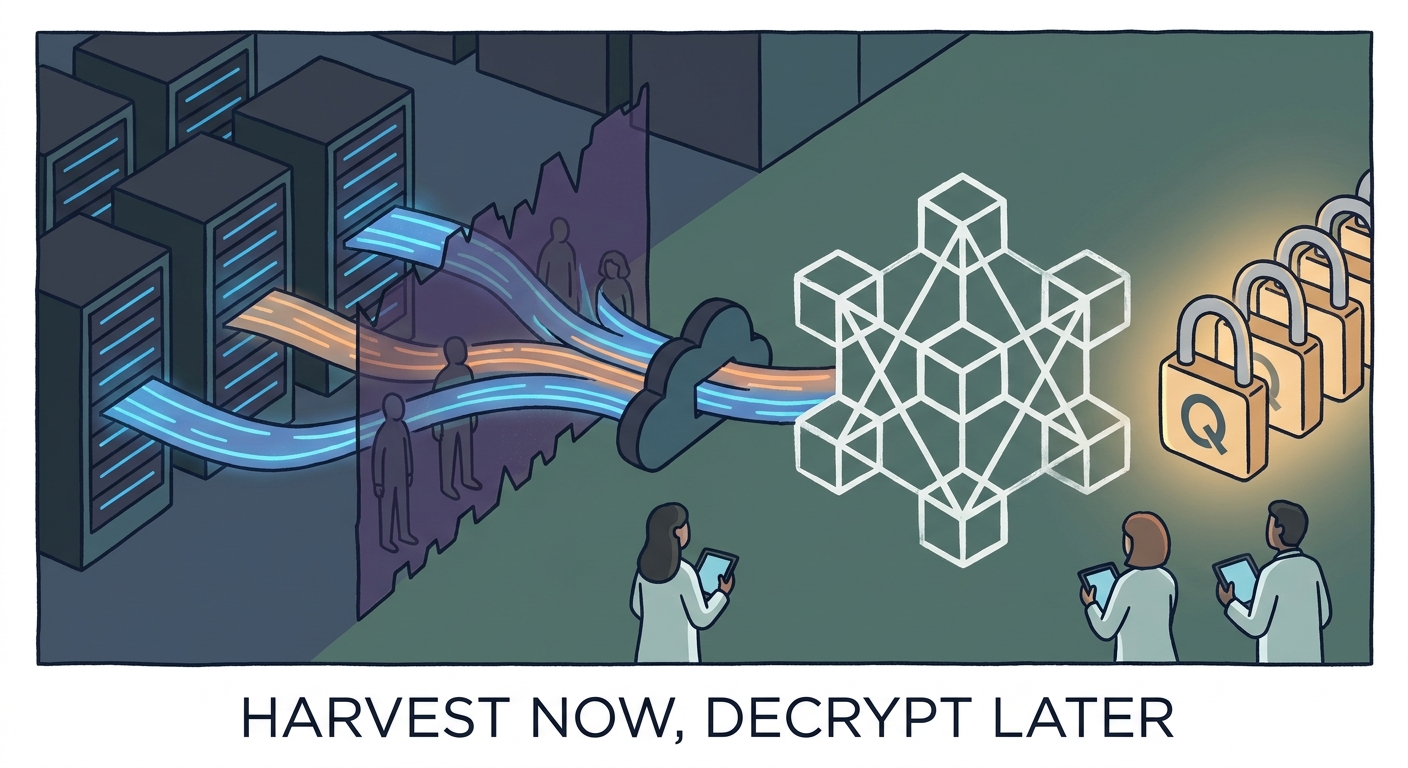
The "Store Now, Decrypt Later" (SNDL) Trap
The biggest lie in cybersecurity is that quantum threats are a "problem for the 2030s." It’s a convenient thought, but it’s dangerously wrong.
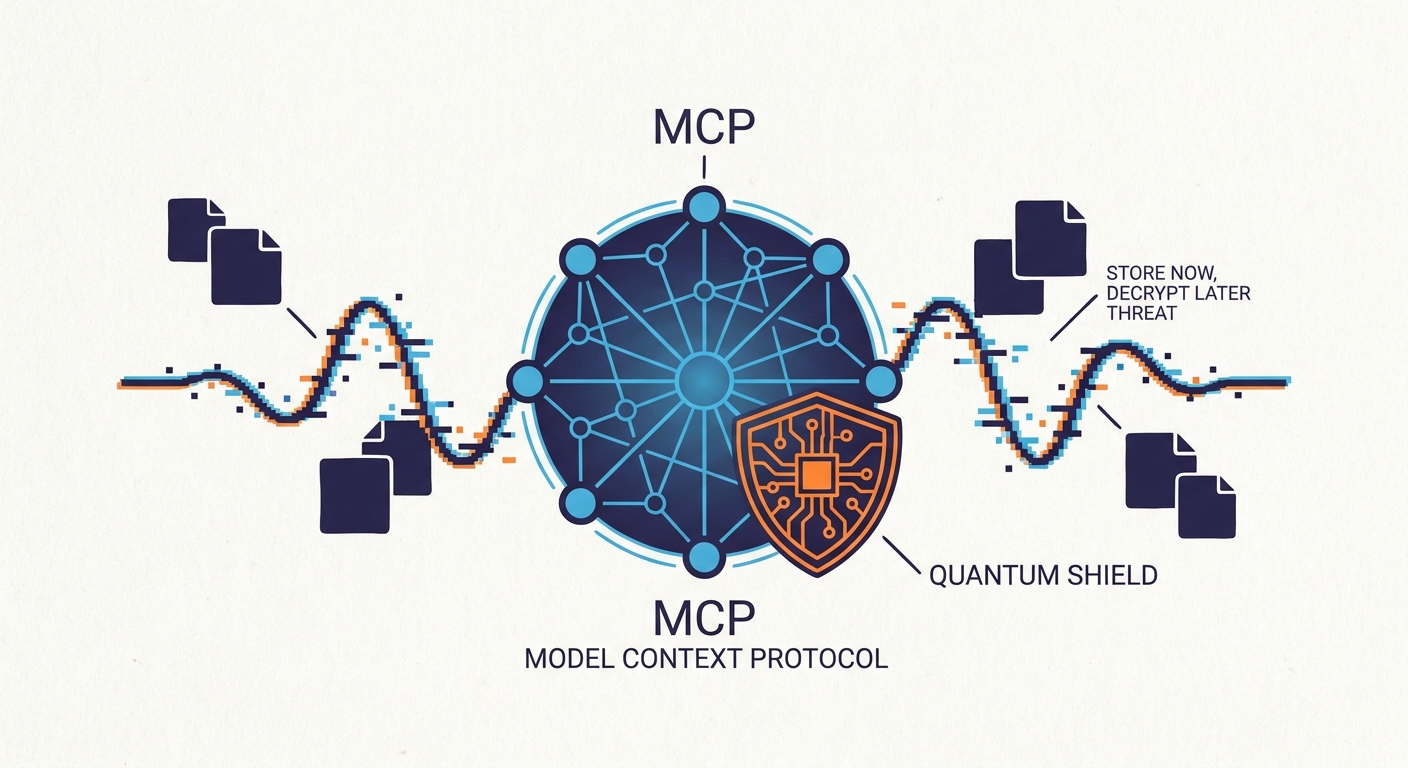
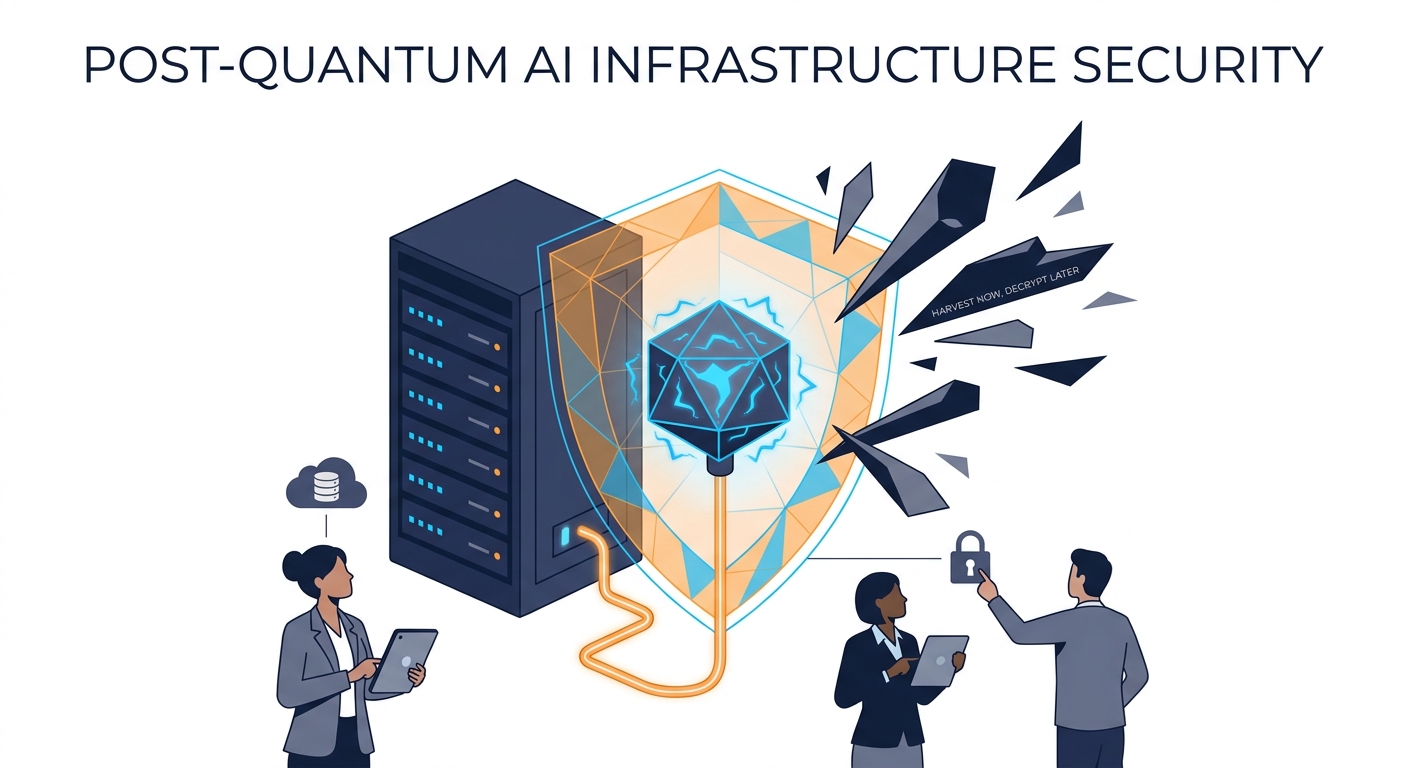
Enter the "Store Now, Decrypt Later" (SNDL) attack. Nation-states and well-funded syndicates are currently vacuuming up massive amounts of encrypted traffic. They don’t have to break your encryption today. They just have to hold onto the raw, encrypted data until they have a fault-tolerant quantum computer.
Once that hardware hits the street, your archives—your proprietary model weights, your customer lists, your long-term strategic roadmaps—will be an open book. If you wait until a quantum computer is actually "active" to start worrying, you’ve already lost. Your most sensitive data will have been sitting in the wrong hands for years. You must adopt algorithms that laugh at Shor’s algorithm today—not tomorrow.
Is the Model Context Protocol (MCP) the New Weakest Link?
As AI orchestration shifts toward the Model Context Protocol (MCP), we’ve inadvertently created a massive, high-friction attack surface. MCP makes it easy for agents to talk to data, which is great for productivity—and a disaster for security.
Supply chain risks have gone systemic. Today, a hacker can spin up "server lookalikes" that masquerade as legitimate data sources. Your agent, thinking it’s talking to a trusted internal database, just pipes sensitive context directly into an adversary’s control. It’s a classic bait-and-switch.
The only way out is identity-based verification. If you don't have a rock-solid, cryptographically sound handshake for every single agent-to-data call, you’re just trusting whoever walks through the door. If you are protecting MCP deployments in 2026, you need to enforce strict, policy-based access controls. Every agent needs to prove who it is before it gets a single token of context.
Architecting for a Post-Quantum Reality
You don’t have to burn your current stack to the ground. Think of it as layering on a new set of armor. The secret sauce is the Hybrid Cryptography Standard.
By running classical encryption (RSA/ECC) alongside NIST-approved Post-Quantum Cryptography (PQC) algorithms like ML-KEM, you get the best of both worlds. You’re covered against current-gen attacks and future-proofed against quantum decryption.
Next, you need to adopt Zero-Trust for AI Agents. Kill the idea of permanent access. Every agent session should be ephemeral—a one-time, task-specific pass that expires the moment the job is done. Finally, start using "AI-on-AI" monitoring. Deploy security agents to watch your production agents. If an agent suddenly starts acting weird—like asking for data that’s way outside its job description—your security agent should be able to spot the anomaly and cut the connection in real-time.
Your 2026 Quantum-Ready Checklist
This isn't a weekend project. It’s a transition that requires a methodical approach.
- Phase 1: Cryptographic Inventory. You can’t protect what you don’t see. Map out every single place where classical encryption is guarding your critical AI assets. Audit your dependencies.
- Phase 2: Transitioning to Hybrid Crypto-Agility. Start moving your key exchange and digital signature protocols to hybrid systems. Aim for "crypto-agility"—the ability to swap out an algorithm without having to tear down your entire backend architecture.
- Phase 3: Hardening the MCP Orchestration Layer. Implement identity-based verification for every single agent interaction. For more guidance, check out The 2026 Roadmap to Post-Quantum AI Infrastructure Security to make sure you’re hitting the right industry benchmarks.
Hard Lessons from the Supply Chain
Recent attacks have proven one thing: the bridge between an AI agent and its data source is where things fall apart. We’ve seen scenarios where compromised MCP servers were used to siphon off proprietary training parameters. According to the OECD AI Incident Tracker, supply chain vulnerabilities are spiking precisely because we trust third-party integrations too much.
A quantum-resilient policy layer would have stopped these attacks cold. If your infrastructure demands PQC-backed identity verification for every single handshake, a fake server gets rejected instantly—no matter how legitimate it looks. Trust nothing. Verify everything. Enforce your policy at the protocol level.
Standardizing for the Future
We can’t afford a fragmented, "every company for itself" approach. The work coming out of the NIST Post-Quantum Cryptography Standardization project is the bedrock we all need to build on.
Stop viewing security as a static perimeter. It’s a fluid, identity-centric necessity. By aligning with these standards today, we build a future where AI agents can actually be useful—and autonomous—without leaving the vault door wide open for the next decade of threats.
Frequently Asked Questions
Why should we care about quantum threats today if quantum computers are years away?
The SNDL threat makes this a present-day reality; data encrypted today is being harvested for future decryption, meaning your proprietary AI assets are already at risk of being exposed in the long term.
Is current encryption completely useless against quantum computers?
Current encryption is not useless, but it is insufficient. A hybrid approach—layering PQC on top of established classical encryption—provides the necessary defense-in-depth required for the transition period.
How does Model Context Protocol (MCP) change the security landscape?
MCP democratizes agent-to-data access, which inherently expands the attack surface. It forces a departure from network-based security to a model centered on granular, policy-based identity verification.
What is the primary advantage of the "AI-on-AI" security paradigm?
It allows for real-time behavioral analysis within model context windows, enabling the detection of malicious agent behavior that traditional signature-based security tools would completely miss.