Building Future-Proof AI Infrastructure: Integrating Quantum Cyber Security into MCP

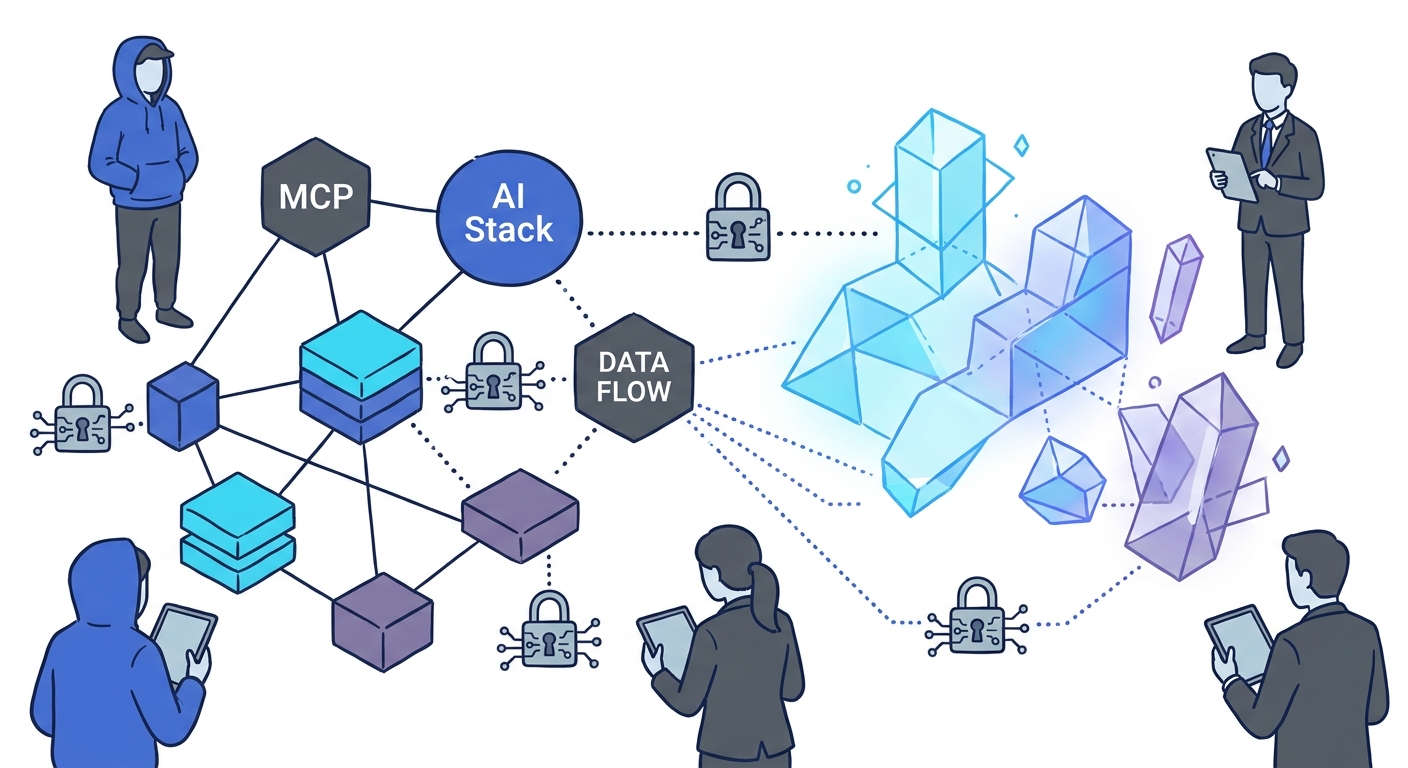
TL;DR
- ✓ Protect enterprise AI data against Store Now Decrypt Later quantum threats.
- ✓ Understand how MCP implementations can act as vectors for agentic poisoning.
- ✓ Implement post-quantum cryptography to secure sensitive agentic workflows and pipelines.
- ✓ Defend your AI infrastructure by moving beyond standard TLS security protocols.
The Model Context Protocol (MCP) has quietly become the backbone of the 2026 enterprise AI stack. It’s the connective tissue that lets our LLMs actually talk to our data. It’s elegant, it’s efficient, and it’s fast becoming the standard. But there’s a catch.
As we drift away from simple, static API calls toward complex, agentic flows, we’re opening a door we haven’t fully secured yet. We’re handing these agents the keys to the kingdom, but the locks we’re using? They’re getting rusty. Standard TLS isn't enough anymore. If we want to survive the "Store Now, Decrypt Later" (SNDL) era, we need to talk about Post-Quantum Cryptography (PQC). Because right now, every packet of data traveling through your MCP pipelines is effectively a ticking time bomb.
The Real Threat: Why "Store Now, Decrypt Later" is an Existential Crisis
Let’s be honest: SNDL sounds like something out of a techno-thriller. But the reality is boring, terrifying, and happening right now. Adversaries are harvesting encrypted traffic by the petabyte. They aren’t trying to crack it today. They’re dumping it into massive cold-storage warehouses, waiting for the day they have the quantum compute power to shred RSA and ECC encryption like it’s wet tissue paper.
For a standard web request, that’s a headache. For your AI infrastructure? It’s an existential crisis. As detailed in the Cloud Security Alliance: AI Infrastructure Research, the risk isn't just "data." It’s context.
When your agentic workflows move, they aren't just sending a prompt. They’re sending a blueprint. You’re shipping PII, credentials, and deep-seated proprietary logic across the wire. If someone scrapes that today, they’re holding onto your enterprise’s DNA. The moment quantum-capable machines hit the mainstream, that "harvested" data becomes a weapon. They won’t just see what you’re doing; they’ll be able to reverse-engineer your entire model architecture and waltz into your internal systems.
Is Your MCP Implementation a Trojan Horse?
There is a more immediate threat than future decryption, and it’s happening in real-time: "Agentic Poisoning."
In the MCP ecosystem, your AI agent is fundamentally trusting. It looks at the schema provided by the MCP server and says, "Okay, these are the tools I can use." What happens when an attacker gets their hands on that schema? They can warp the agent’s reality. They can trick your AI into executing unauthorized actions—essentially turning your most powerful productivity tool into an unwitting insider threat.
Your firewall won't save you here. It sees valid HTTPS traffic and lets it pass. It doesn't understand the intent of an MCP call. It sees a green light where there should be a red one.
Because these agents operate at machine speed, the damage is often done before a human operator even realizes something is wrong. By the time you notice, the account is drained, the data is gone, or the system is compromised.
Architecting a Quantum-Resistant MCP Layer
If you’re still relying solely on standard TLS, you’re playing a losing game. Shor’s algorithm is the elephant in the room, and it’s going to make our current mathematical security look like a screen door in a hurricane.
The fix? A Hybrid Cryptographic Approach. You don't abandon your current setup overnight; you layer it. By combining classical Elliptic Curve Cryptography (ECC) with NIST-approved PQC algorithms—like ML-KEM and ML-DSA—you create a defensive posture that’s both compatible and future-proof.
For teams looking to move the needle, checking out Quantum-Resistant Security Solutions is the logical next step. You’re essentially building a dual-lock system. Even if one side of the cryptographic chain gets compromised, the other holds the line.
Beyond Checkboxes: NIST-Aligned Governance
Governance isn't about filling out a spreadsheet. It’s about operational reality. You need to adopt the NIST AI Cybersecurity Framework (CSF) and apply it specifically to your MCP traffic.
Ask yourself: Do I know exactly what data is moving between my model and my tools? Can I prove it hasn't been tampered with?
You need "Zero Trust for Agents." Stop trusting the connection just because the handshake happened. Verify every single MCP server connection. As highlighted in the NSA AI Security Center (AISC) Guidance, you have to assume the network is already compromised. By implementing MCP Risk Mitigation Strategies, you’re building a sandbox. The agents can play, but they can’t set the house on fire.
Gateway Logic: The "Secure MCP Gateway"
If we want to stop poisoning, we have to stop the "trust-all" mentality. You need a middleman.
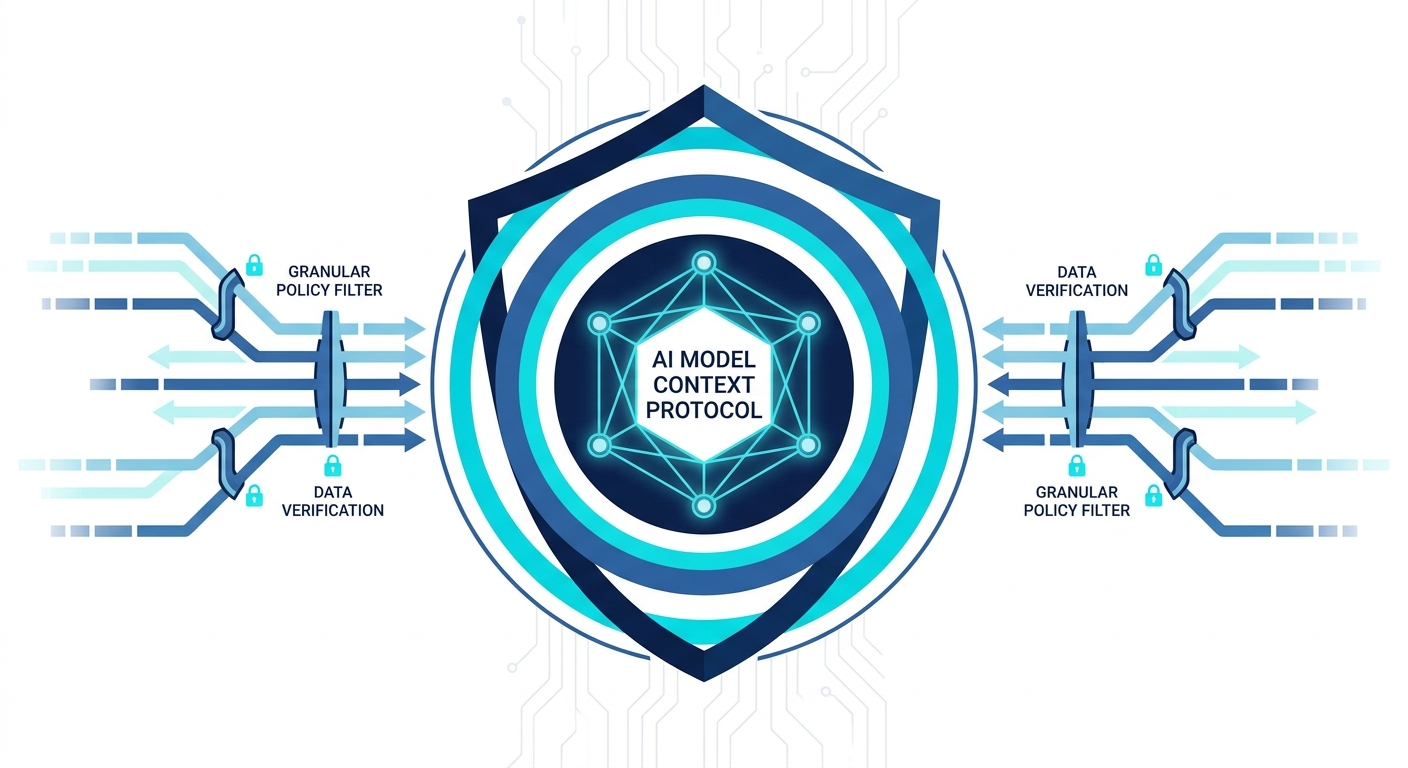
A "Secure MCP Gateway" sits between your client and the MCP server. It’s an inspection point. It sanitizes the context, checks the schemas for malicious intent, and enforces policy before the LLM ever gets its hands on the data.
This is the "Least Privilege" principle applied to AI. If the agent doesn't need to touch that specific tool, the gateway shuts it down. If the schema looks fishy, the gateway blocks it. It’s the ultimate circuit breaker for your agentic workflow.
Frequently Asked Questions
Does the Model Context Protocol (MCP) inherently support quantum-resistant encryption?
No, MCP is a transport-agnostic protocol. It provides the structure for communication but does not dictate the encryption layer. Security, including the implementation of post-quantum standards, must be handled by the developers at the transport and application layers of their specific MCP implementation.
Why should I worry about quantum threats in 2026 if quantum computers aren't fully functional yet?
You should worry because of the "Store Now, Decrypt Later" (SNDL) threat. Adversaries are actively harvesting encrypted data today, betting on the fact that they will eventually be able to decrypt it. If your AI agent is transmitting proprietary data or credentials, that information is essentially a long-term liability if it remains encrypted only with classical algorithms.
What is the most immediate security risk when deploying MCP?
The most immediate risk is tool poisoning and insecure authorization. Because MCP allows AI agents to interact with internal tools, a compromised or manipulated schema can allow an agent to perform actions that it was never intended to do, potentially leading to unauthorized data access or system manipulation.
How does hybrid encryption protect my current AI workflows without breaking legacy integrations?
Hybrid encryption works by wrapping your traffic in two layers of protection: a classical layer for compatibility with existing systems, and a PQC layer that provides quantum resistance. This ensures your current environment continues to function while simultaneously securing your data against future decryption threats.