The 2026 Guide to Post-Quantum AI Infrastructure Security: Protecting MCP Deployments

TL;DR
- ✓ Understand the Store Now Decrypt Later threat to your AI infrastructure.
- ✓ Identify why Model Context Protocol serves as a critical attack surface.
- ✓ Learn strategies to implement quantum-resistant security for agentic workflows.
- ✓ Protect sensitive enterprise data from future quantum decryption capabilities.
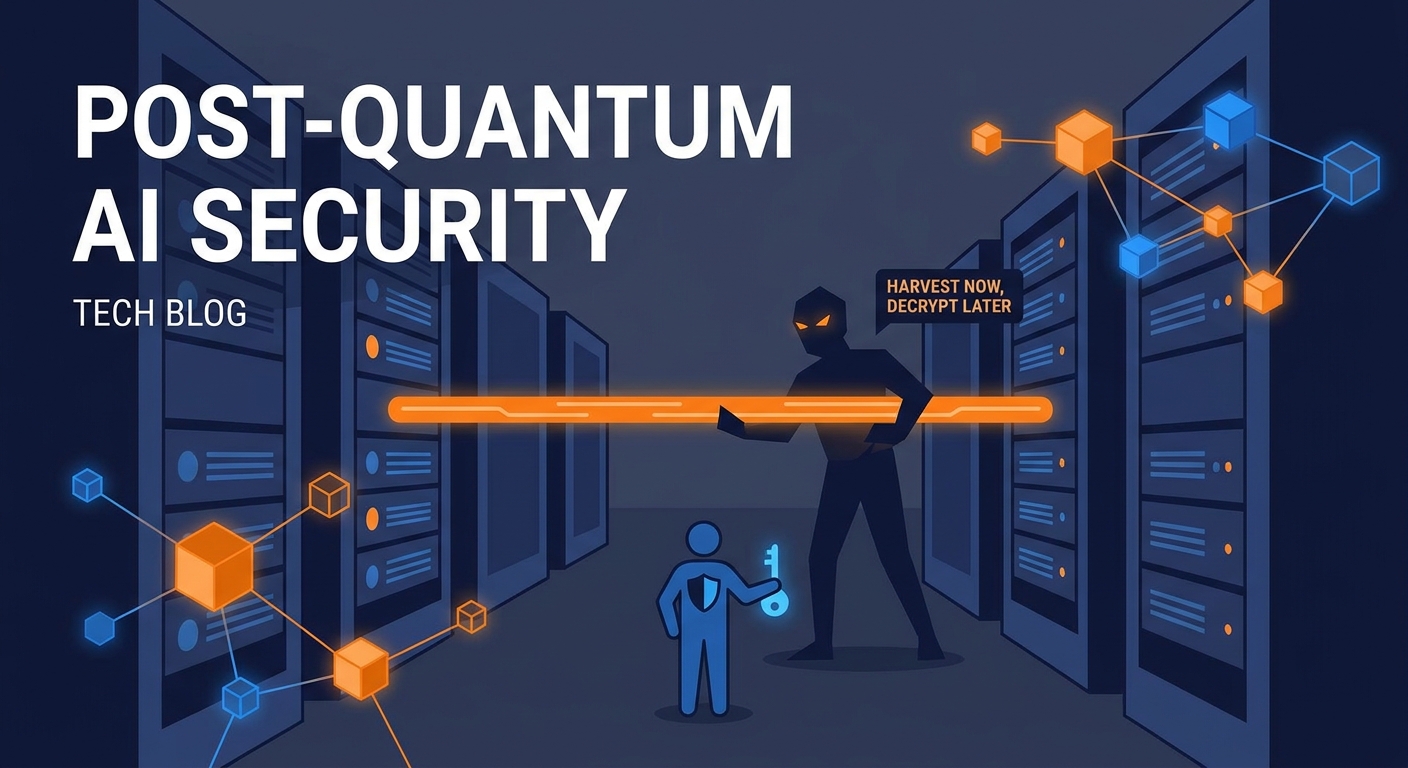
The modern enterprise is trapped in a $2.5 trillion security paradox. We are pouring mountains of capital into autonomous agents and LLM-integrated workflows, yet we’ve left the back door wide open to the quantum threat. By 2026, the "Store Now, Decrypt Later" (SNDL) nightmare has moved from a paranoid academic theory to a boardroom mandate.
State actors and sophisticated syndicates are harvesting encrypted traffic from AI infrastructure right now. They aren't trying to crack your AES-256 keys today. They’re banking on the eventual maturity of cryptographically relevant quantum computers (CRQCs) to unlock today’s secrets tomorrow. Protecting your AI ecosystem isn’t just about access control anymore; it’s a high-stakes race to ensure your data stays private in a world where today’s encryption standards will be rendered useless.
What is the Model Context Protocol (MCP) and Why is it the Primary Attack Surface?
The Model Context Protocol (MCP) has become the connective tissue of the modern AI stack. It’s the standard way LLMs talk to enterprise data, SaaS platforms, and internal code repositories. The architecture—host, client, and server—is elegant, sure. But its ubiquity makes it the juiciest target for lateral movement in your network.
When an LLM requests data from a database, the MCP server acts as the middleman. If an attacker compromises the transport layer between these nodes, they get a front-row seat to the most sensitive "thought processes" and data payloads your organization owns.
Because the MCP server translates natural language into structured backend queries, developers often view it as a "trusted" bridge. That’s a mistake. In reality, this bridge is a high-value target for schema manipulation and injection attacks. If your infrastructure doesn't treat the MCP transit path as hostile, you’re essentially rolling out the red carpet for adversaries to live inside your agentic workflows.
The Quantum Link: Why "Store Now, Decrypt Later" Threatens Your MCP Deployments
The danger isn't just that your traffic could be intercepted; it’s that it’s being archived for the future. According to the Cloud Security Alliance: AI Infrastructure PQC Report, the window of vulnerability for data with a 5+ year sensitivity horizon is already slammed shut.
Static encryption—the kind most organizations rely on for internal API calls—is a massive liability. If you are transmitting PII, proprietary source code, or strategic financial data through an MCP deployment using standard TLS/SSL, you are effectively publishing that data in a "wait-and-read" format for future quantum actors.
We need to transition to post-quantum transport layers yesterday. We are moving toward a world where encryption must be as dynamic as the AI agents themselves, yet most legacy infrastructure is still tethered to cryptographic standards from the late 90s.
How Do You Classify Risk in an MCP-Driven Ecosystem?
Security in an agentic environment demands a dual-lens approach. First, you have to look at protocol-level risks: schema manipulation and prompt injection. These can trick an MCP server into coughing up data it was never supposed to touch. The OWASP MCP Top 10 Project is the best place to start identifying these vulnerabilities.
Second, you have to fix the "Human-in-the-Loop" gap. The most common exploit in 2026 remains the over-privileged token. If an MCP server is configured with a broad read/write token to your production database, an LLM hallucination or a clever injection attack can lead to total data exfiltration. Audit logging is often the missing piece. If you can’t prove what an agent was authorized to do at the exact moment of an interaction, you can’t conduct forensics. You’re just guessing.
Moving Toward "Crypto-Agility": How Do You Future-Proof Your Architecture?
Crypto-agility is the ability to swap cryptographic implementations without tearing down your entire application logic. In the context of MCP, this means decoupling your transport layer security from the agent logic. Stop hard-coding RSA or ECC into your services. Instead, implement an abstraction layer that allows for the seamless integration of NIST Post-Quantum Cryptography Standards.
By adopting algorithms like ML-KEM and ML-DSA, you ensure that even if a specific cryptographic module is found to be weak against a new quantum-based attack, you can update the module without breaking the underlying MCP connection.
Actionable Mitigations: The Quantum-Ready Checklist for SecOps
To survive the shift to quantum, you need to abandon the idea of "perimeter defense." Security must be an architectural requirement. Follow this three-step hardening process:
- Inventory: You cannot protect what you haven't mapped. Use automated tooling to catalog every MCP server, its associated permissions, and the sensitivity of the data it touches.
- Scoping: Implement granular, policy-based access control for every agent token. If an agent only needs read access to a specific schema, lock that token down. For deeper insights on hardening these connections, consult the Gopher Security: Quantum-Resistant Algorithms Guide.
- Hardening: Force PQC-ready transport layer encryption for all inter-service communication. If your current service mesh doesn't support the latest NIST standards, it’s time to move on to a modern, crypto-agile alternative.
Operationalizing Security: Policy-as-Code for MCP
Manual security reviews are dead. They simply cannot keep pace with the speed of AI deployment. You must shift to "Policy-as-Code" using tools like Open Policy Agent (OPA) to enforce least-privilege on your MCP servers automatically. By defining your security posture in code, you ensure that every agent-to-server interaction is validated against your compliance policy before a single byte of data is transmitted. For common questions on how to integrate these policies, refer to the Gopher Security: MCP Security FAQ. Automated audit trails aren't just about ticking boxes for compliance—they are the only way to maintain visibility when your agents are executing thousands of micro-transactions per second.
Closing: The Future of AI Infrastructure Security
The transition to mandatory PQC compliance is already underway. By 2027, expect federal and international procurement standards to require quantum-resistant infrastructure for all AI deployments. The "Security-by-Design" mandate is no longer optional for CTOs. We are currently in a grace period—a narrow window where we can secure our infrastructure before the quantum threat becomes an immediate, operational reality. The organizations that succeed will be those that view crypto-agility not as an IT burden, but as a competitive advantage that allows them to move faster and more securely in an increasingly adversarial landscape.
Frequently Asked Questions
Does the Model Context Protocol (MCP) inherently support quantum-resistant encryption?
Not natively at the protocol level yet, but it is designed to be transport-agnostic. You can and should wrap your MCP traffic in PQC-ready transport layers, such as TLS 1.3 with integrated quantum-resistant key exchange mechanisms.
Is "Store Now, Decrypt Later" a real threat to my AI agents today?
Absolutely. If your agents handle long-term sensitive data, such as customer identity information or intellectual property, that data is currently being harvested by sophisticated actors. Retrospective decryption is a significant business continuity risk for any organization planning to operate in 2030 and beyond.
How do I make my MCP deployments "Crypto-Agile"?
You achieve this by decoupling your cryptographic implementations from your application logic. By using an abstraction layer or a security sidecar, you can swap out legacy encryption modules for modern, NIST-approved PQC algorithms without requiring a full refactor of your agentic code.
What is the biggest security risk in MCP right now?
The biggest risk is the over-privileged MCP server. When developers assign broad permissions to an MCP server to "make things easier," they effectively grant the connected LLM power to manipulate backend systems far beyond the scope of its intended function.
How should SecOps teams bridge the skill gap for PQC implementation?
Focus on the shift from manual configuration to policy-as-code. By automating the enforcement of security policies, your team doesn't need to be a cryptographer to maintain a secure environment; they need to be proficient in managing the policy engines that enforce these standards across the infrastructure.