2026 Industry Analysis Ranks Top Tools for Assessing Quantum Attack Risks in Crypto Exchanges


TL;DR
- Quantum computing poses an existential "Q-Day" threat to current crypto exchange encryption.
- Industry analysis identifies seven essential tools for mapping cryptographic vulnerabilities.
- Over $600 billion in Bitcoin remains vulnerable to Shor’s algorithm-based attacks.
- Financial institutions must migrate to post-quantum cryptography (PQC) by 2035.
- Effective defense requires automated cryptographic inventory and CI/CD pipeline integration.
"Q-Day" isn’t just a buzzword anymore—it’s the looming deadline on every CISO’s calendar. It marks the moment when quantum computing power finally outpaces our current encryption, turning today’s "unbreakable" security into tomorrow’s open door. For crypto exchanges, the stakes are existential. A 2026 industry report has finally cut through the noise, identifying seven essential tools designed to help these platforms map their cryptographic vulnerabilities before a quantum-enabled adversary does it for them.
The pressure is mounting. The Financial Services Information Sharing and Analysis Center (FS-ISAC) has set a hard 2035 deadline for financial institutions to migrate to post-quantum cryptography (PQC). While the World Federation of Exchanges (WFE) suggests we might have 5 to 10 years before cryptographically relevant quantum computers (CRQCs) actually hit the scene, the industry is already fighting a shadow war. We’re talking about "harvest-now, decrypt-later" attacks—where bad actors scoop up encrypted data today, waiting for the day they can crack it open like a walnut.
For digital asset platforms, this is a massive headache. If you look at the Project 11 Yellowpages dataset, roughly 6.3 million Bitcoin—worth about $648 billion as of early 2025—is sitting in the crosshairs of quantum risk. The culprit? The Elliptic Curve Digital Signature Algorithm (ECDSA). It’s the backbone of Bitcoin and Ethereum, but it’s also exactly the kind of math Shor’s algorithm is designed to shred. If that foundation cracks, the entire ecosystem feels the tremor.
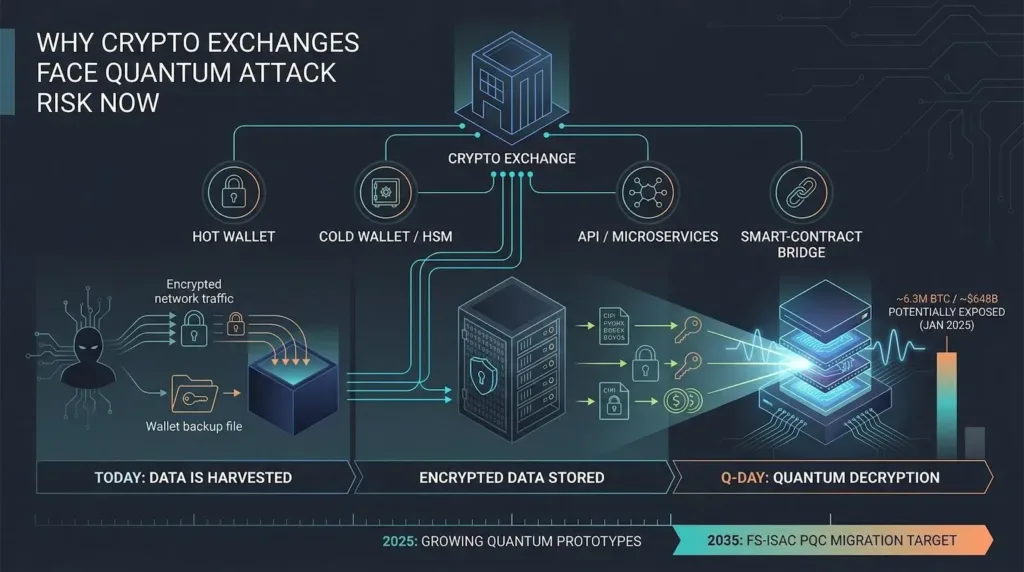
To stay ahead of the curve, exchanges are turning to structured migration frameworks. Research in Computers & Security suggests a three-stage approach: pre-migration, through-migration, and post-migration. By applying the STRIDE threat model to everything from certificates to network protocols, firms are finally building a roadmap for their public key infrastructures (PKI).
When vetting these new assessment tools, the leaders in the space are focusing on three non-negotiables:
- Cryptographic Inventory: You can’t protect what you can’t see. These tools automate the discovery of every key, algorithm, and certificate lurking in the infrastructure.
- Pipeline Integration: If your CI/CD pipeline doesn't flag non-quantum-safe dependencies, you’re just building technical debt. These tools plug directly into the deployment process.
- Compliance Documentation: Regulators are waking up. These tools generate the paper trail necessary to prove you’re actually working toward quantum preparedness.
| Migration Stage | Focus Area | Primary Objective |
|---|---|---|
| Pre-migration | Cryptographic Inventory | Identify and map all vulnerable assets |
| Through-migration | Algorithmic Transition | Replace weak protocols with PQC standards |
| Post-migration | Validation & Auditing | Ensure system integrity and compliance |
Despite the clear and present danger, the mood in the boardroom is cautious. The WFE Global Cybersecurity Working Group notes that many operators are still prioritizing Generative AI and immediate, high-frequency cyber threats over the "long-term" quantum problem. It’s a classic balancing act: how much do you spend today on a threat that might not fully materialize for a decade?
Industry leaders are pushing for a middle ground. As outlined in industry perspectives on quantum computing preparedness, the goal is to weave quantum-safe criteria into standard procurement cycles. This way, you’re upgrading your security posture as a matter of routine, rather than blowing your entire budget on a panic-driven overhaul.
This shift toward proactive assessment is a sign of a maturing industry. By aligning with global cybersecurity priorities, exchanges are moving toward a defense-in-depth strategy that assumes the quantum threat is inevitable. As the 2035 deadline from ISACA and other bodies approaches, these frameworks won't just be "best practices"—they’ll be the baseline for anyone who wants to play in the institutional digital asset market.
At the end of the day, this is as much a management challenge as it is a math problem. It’s about knowing what you have, knowing where it’s weak, and having the discipline to fix it before the clock runs out. As the American Banker has pointed out, the firms that navigate this transition effectively will be the ones left standing when the dust settles on the next decade of digital finance.