Building Future-Proof AI Infrastructure: A Guide to Quantum-Resistant Encryption

TL;DR
- ✓ State-level actors use Store Now Decrypt Later to compromise future encrypted AI data.
- ✓ Current RSA and ECC encryption standards remain vulnerable to future quantum computing threats.
- ✓ Model Context Protocol deployments require hybrid quantum-resistant tunnels to prevent critical data interception.
- ✓ Implementing cryptographic agility is an essential survival requirement for 2026 enterprise AI security.
Forget about the latest zero-day exploit or some clever prompt injection trick for a second. The real threat to your AI stack isn't something that’s happening right now—it’s something that’s already happened.
State-level actors are currently vacuuming up your encrypted traffic. They aren't trying to break it today; they’re just banking it. This is the "Store Now, Decrypt Later" (SNDL) strategy. They know that while current RSA and ECC encryption keeps them out today, it’ll be child’s play once fault-tolerant quantum computers (FTQC) hit the scene. If you’re piping sensitive proprietary data or internal AI reasoning logs across your network, you’re essentially handing your company’s future to your adversaries on a silver platter.
Transitioning to quantum-resistant encryption isn't some academic exercise for math geeks. It’s a 2026 enterprise survival requirement. It’s time to move away from static, legacy encryption and embrace cryptographic agility.
Why the Model Context Protocol (MCP) is a Target
The Model Context Protocol (MCP) has become the glue holding the modern AI stack together. It’s the connective tissue that lets your LLMs talk to your enterprise data. But there’s a catch: this connectivity is a massive, distributed attack surface.
When you plug your high-value knowledge base into an AI agent via MCP, you’re creating a high-value data stream. Often, that stream is wrapped in the same aging TLS protocols that quantum computers are destined to rip apart. Many teams make the mistake of thinking TLS 1.3 is bulletproof. It’s not. Since MCP transmits the very "context" that gives you a competitive edge—think internal strategy, private code, and customer secrets—it’s a prime target for interception. If you want to see exactly how these connections get compromised, learn more about our comprehensive MCP Security Framework. It breaks down the vulnerabilities baked into these cross-protocol communications.
The Reality of the Quantum Threat
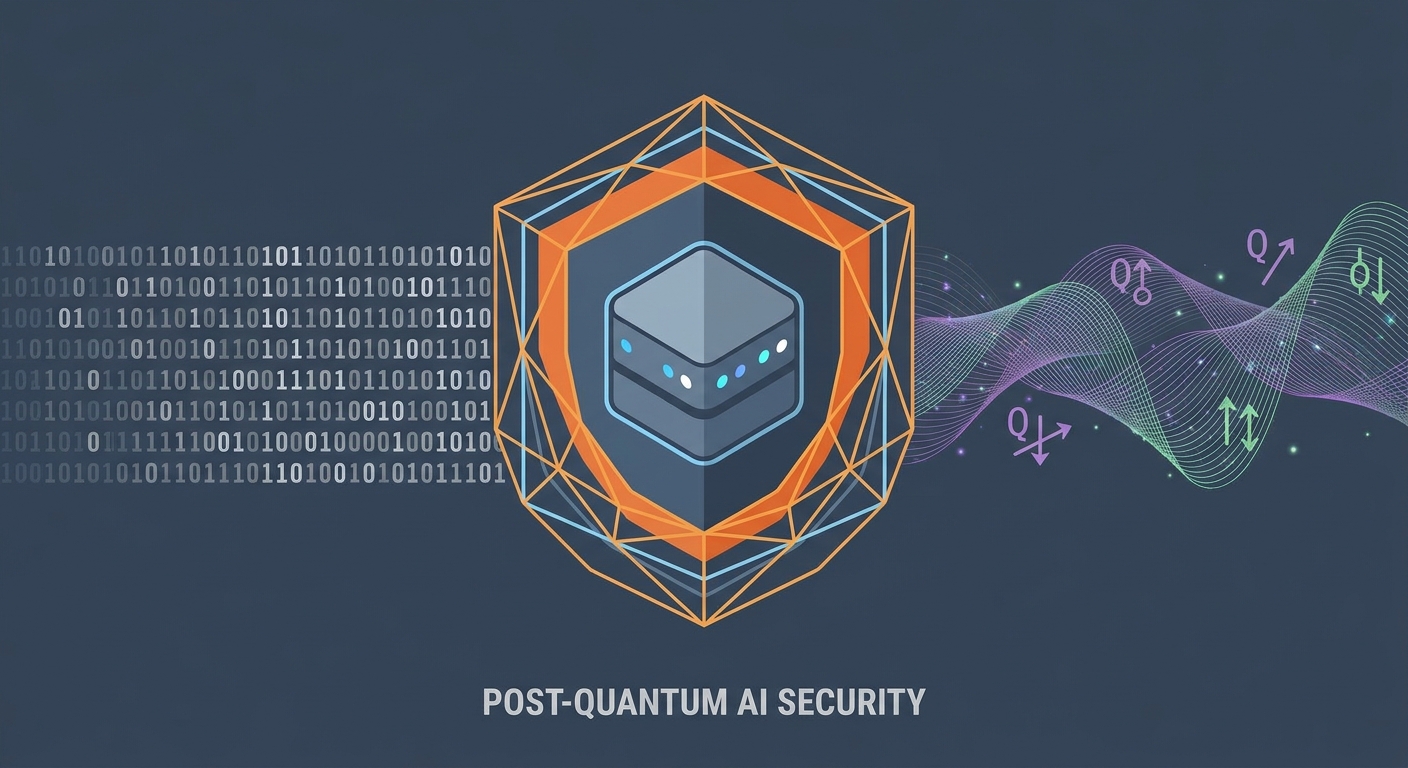
The SNDL methodology is terrifyingly simple. Attackers don't need to break your code today. They just record the traffic, dump the ciphertext into a server farm, and play the long game. For AI reasoning paths—where an LLM might be chewing through your entire corporate strategy—the value of that data only grows the longer it sits in an adversary's hands.
As the diagram shows, once you switch to a hybrid tunnel, that captured traffic is effectively dead weight. Even if they store it for a decade, the quantum-resistant layer ensures the key exchange can't be mathematically reversed. It’s a digital deadbolt.
Implementing Hybrid Cryptography (Without Breaking Everything)
Every CTO I talk to is terrified of "breaking the stack." It’s a valid fear. The good news? You don't need an overnight, rip-and-replace nightmare. The industry is moving toward a "Hybrid Shift."
Instead of tossing out your current setup, you layer post-quantum algorithms—specifically those using ML-KEM (Kyber)—on top of your classical algorithms. Think of it as a belt-and-suspenders approach. If the quantum-resistant algorithm hits a snag, your classical encryption still holds the line against today’s threats. If the classical math falls to a quantum computer, the PQC layer keeps the door locked. To get into the weeds of the technical specs, review the official NIST Post-Quantum Cryptography Standards. It’s not about choosing one or the other; it’s about building architectural redundancy.
The "Quantum-Ready" Blueprint
Quantum readiness is all about agility. You need the ability to swap algorithms as the threat landscape shifts, without having to rebuild your entire application from the ground up. Start by auditing your nodes. Look specifically for long-lived data connections—those are the ones being harvested for future decryption.
When you move from hard-coded, static encryption to a software-defined security layer, you’re finally in the driver’s seat. For a deep dive into how this looks in practice, read our full Post-Quantum AI Infrastructure Security Framework. It outlines the exact migration path for enterprise AI.
The Hard Truth: PQC Isn't a Silver Bullet
Here is where people get it wrong: deploying PQC does not make your AI "secure." It only secures the pipe.
PQC protects the transport layer, but it does absolutely nothing for the payload. If you encrypt the channel between your database and your LLM, but your model is still vulnerable to prompt injection or tool poisoning, you’re still wide open. A quantum-resistant tunnel is useless if your AI is tricked into leaking the data you just spent a fortune protecting. You have to pair transport-layer security with strict content-integrity checks. If you're managing critical infrastructure, consult CISA Guidance on PQC Adoption to understand the full scope of protecting both transmission and data integrity.
Your 2026 Transition Checklist
Don't try to boil the ocean. Start with the low-hanging, high-risk fruit.
- Phase 1: Audit and Inventory: Find the data flows holding long-lived secrets or sensitive reasoning logs. If that data will still be sensitive in five years, it needs PQC protection today.
- Phase 2: Prioritize MCP Endpoints: Your MCP gateways are the front door to your private data. Focus your security spend here first. Explore the Trail of Bits MCP Security Hub for threat modeling techniques that reveal exactly where your MCP implementation is leaking.
- Phase 3: Enforce Policy: Continuous monitoring is non-negotiable. You need to ensure your hybrid tunnels are actually active and that no "downgrade attacks" are forcing your traffic back to vulnerable, classical-only protocols.
Frequently Asked Questions
Does moving to quantum-resistant encryption mean I have to replace my entire AI stack?
No. Using Hybrid Cryptography allows you to run PQC layers alongside your existing infrastructure, maintaining legacy compatibility without a total overhaul.
Why is Model Context Protocol (MCP) more at risk than standard web traffic?
MCP bridges internal, highly sensitive proprietary data directly to LLMs. If that transport layer is intercepted, the adversary gains access to internal reasoning and strategy documents that are far more damaging than standard web traffic.
When should I start my quantum transition?
If you're transmitting sensitive data over long-lived connections, you’re already behind. "Quantum-readiness" is a 2026 compliance requirement. Planning should have started yesterday.
Does PQC protect my AI from prompt injection and tool poisoning?
No. PQC secures the pipe, not the message. You must combine PQC with robust input sanitization and policy enforcement to maintain the integrity of your AI agents.