Hardening AI-Driven Environments: A Technical Guide to Quantum-Resistant MCP Security

TL;DR
- ✓ HNDL attacks allow adversaries to store encrypted AI traffic for future quantum decryption.
- ✓ Current classical encryption methods like ECC and RSA are vulnerable to quantum computing.
- ✓ Implementing hybrid post-quantum cryptography at the transport layer secures MCP connections.
- ✓ Combining TLS 1.3 with ML-KEM provides essential protection against future security threats.
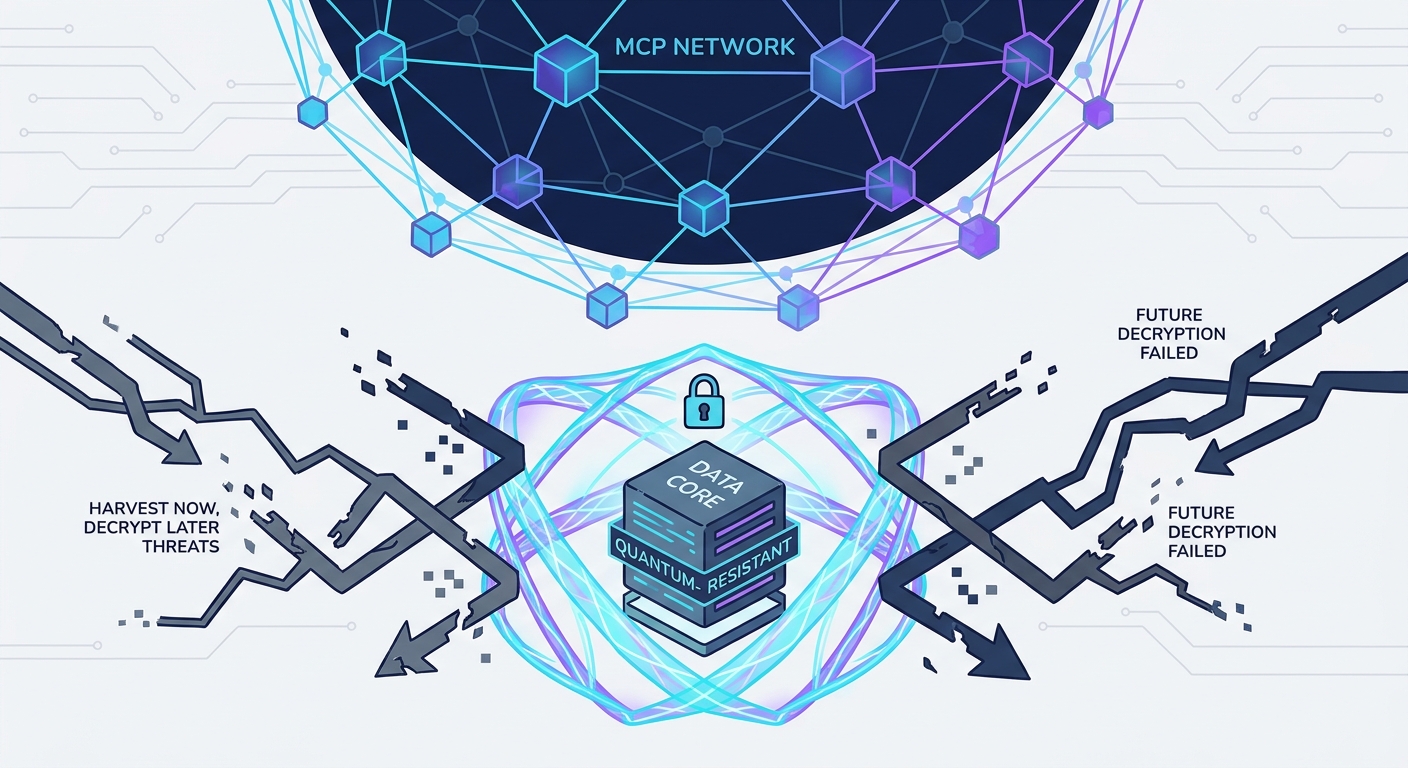
The Model Context Protocol (MCP) has become the connective tissue of the modern enterprise. It’s how AI agents talk to databases, execute code, and pull real-time telemetry. But there’s a catch: it’s also created a massive, exposed perimeter. As we stare down the barrel of cryptographically relevant quantum computers (CRQCs), the data moving through your MCP endpoints is sitting duck for "Harvest Now, Decrypt Later" (HNDL) attacks.
If you want to keep your infrastructure safe, you have to look past standard TLS. You need a hybrid post-quantum cryptography (PQC) framework. It’s the only way to shield your agentic traffic from the threats of tomorrow. For a foundational understanding of why this transition is necessary, see our guide on Quantum-Resistant Cryptography for AI.
What is the Real-World Risk of 'Harvest Now, Decrypt Later' (HNDL)?
Let’s be clear: HNDL isn't some sci-fi plot for the next decade. It’s a tactical reality today. Bad actors are currently intercepting and hoarding encrypted MCP traffic—packets loaded with sensitive model context, PII, and internal tooling credentials. They can't read the data yet. They don't have to. They’re banking on the eventual arrival of quantum compute power to retroactively bust open these streams.
When an agent pulls context from your internal systems, it’s often moving high-value IP. If your transport layer is relying solely on classical ECC or RSA, you’re basically handing over the keys to your internal kingdom. The CISA Post-Quantum Cryptography Initiative makes a vital point: for long-lived data—like the system prompts and historical context logs that train your agents—the window of vulnerability is already wide open. If your agents are touching sensitive endpoints, this isn't just a theoretical breach. It’s a permanent loss of data confidentiality.
Where Does PQC Fit in the MCP Stack?
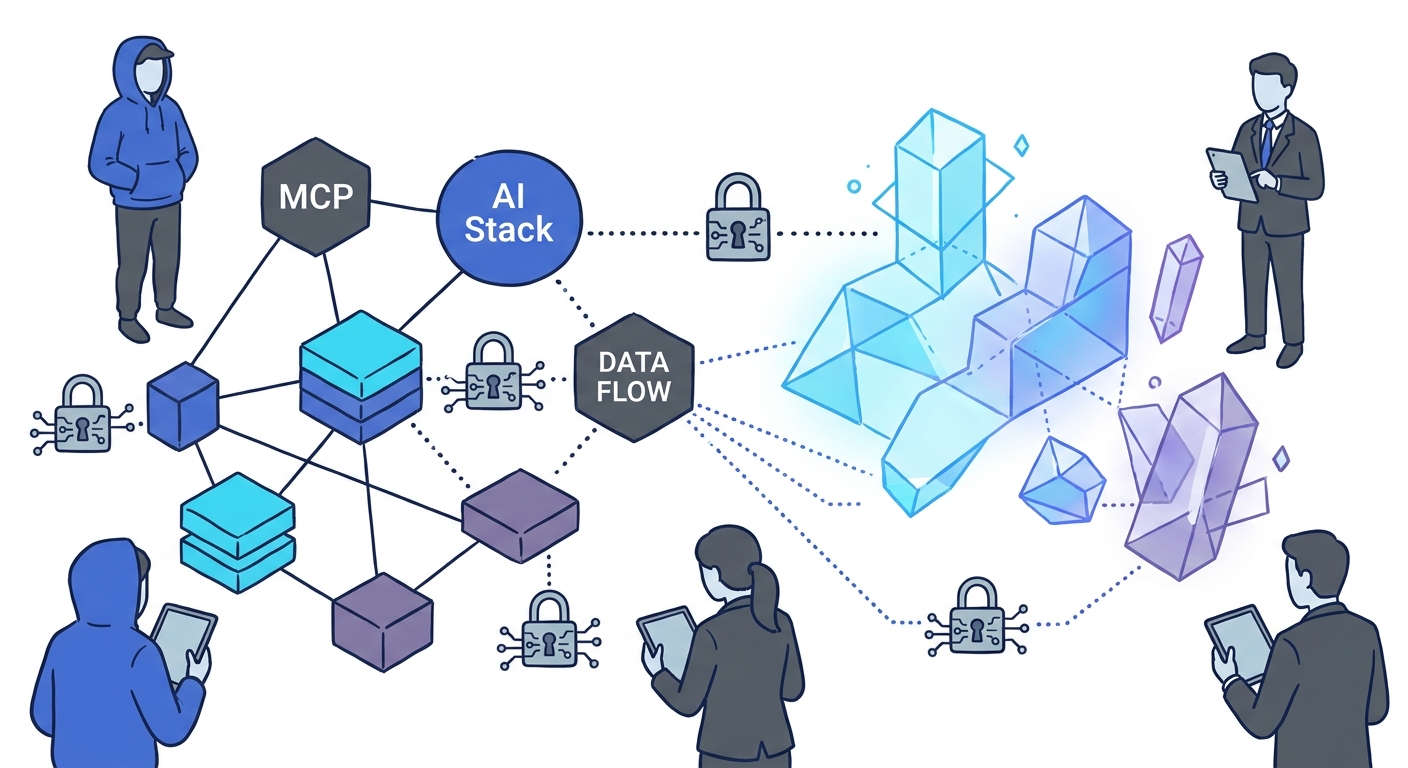
Security architects love to argue about whether to build quantum resistance at the application layer or the transport layer. For MCP, the answer is simple: the transport layer is your primary defensive perimeter. By augmenting standard TLS 1.3 with a quantum-resistant key encapsulation mechanism (KEM), you ensure that even if the underlying classical key exchange gets cracked, the PQC layer keeps the session private.
By dropping in a hybrid PQC wrapper, you’re creating a dual-layered handshake. The classical layer keeps your legacy systems happy, while the PQC layer provides the mathematical muscle needed to resist Shor’s algorithm. It’s the only way to keep the lights on while locking the doors against future-dated decryption attacks.
How Do We Implement Hybrid Cryptography for MCP?
Moving to quantum-resistant infrastructure is an engineering grind, not a policy memo. The "Hybrid" approach means layering classical ECDH with NIST-approved algorithms like ML-KEM. You stay compliant with today's standards while gaining the robustness required to survive a quantum adversary.
Step 1: Inventorying MCP Endpoints and Sensitivity Levels
You can’t protect what you can’t see. Map every MCP server and every agent interaction in your environment. Don't treat them all the same. An agent that just fetches stock tickers is low priority. An agent that touches your production database or internal CI/CD tooling? That’s mission-critical.
Step 2: Selecting NIST Algorithms
Don’t be a hero. Don’t roll your own crypto. Stick to the NIST Post-Quantum Cryptography Standards to pick your primitives. For key establishment, go with ML-KEM (the artist formerly known as Kyber). For digital signatures, prioritize ML-DSA (formerly Dilithium). For a deeper look at how these primitives function, review our breakdown of the Top 5 Quantum-Resistant Cryptographic Algorithms.
Step 3: Integrating the mcp-context-protector Wrapper
Do not try to refactor your entire agent stack. That’s a recipe for disaster. Instead, deploy a mcp-context-protector wrapper. Think of it as a transparent proxy that sits in front of your traffic, upgrades the handshake to include a hybrid KEM, and handles key rotation for you. It’s modular, it’s clean, and most importantly, it won't break your existing agent logic.
The Performance Trade-off: Does PQC Break Agent Functionality?
Engineers are rightfully worried about latency. Nobody wants their AI agents to crawl. It’s true that ML-KEM involves larger key sizes and more compute than standard ECC. But here’s the reality: modern hardware acceleration has made this impact increasingly negligible.
Use connection pooling and session resumption. This amortizes the cost of the initial PQC handshake. Most agent-to-server interactions are long-lived, so that handshake only happens once per session. Once that tunnel is open, the performance difference between classical and quantum-resistant traffic is basically invisible to the end user. If your latency budget is razor-thin, prioritize PQC for your most sensitive data pathways and offload the cryptographic compute to high-performance hardware modules.
Are You Ready for June 2026 Federal Compliance?
The landscape has changed. The upcoming June 2026 federal requirements mandate that agencies and their contractors shift toward "quantum readiness." This isn't a "nice-to-have." It’s an existential requirement for anyone working in the AI agent ecosystem.
If your MCP traffic doesn't meet these criteria, you are non-compliant. Period. The 2026 mandate isn't just about encryption; it’s about the capability to rotate keys and update algorithms as the threat landscape evolves.
How to Build a Resilient MCP Architecture (Case Study)
Consider a firm that recently migrated their legacy agent architecture to a PQC-compliant framework. They had 30 days to lock down 50+ internal MCP endpoints. By using the Trail of Bits MCP Security Hub for auditing, they first uncovered "hidden" endpoints—agent interactions that were logged but completely ungoverned.
They ran a four-week sprint:
- Week 1: Audit and classify every bit of MCP traffic.
- Week 2: Deploy hybrid PQC wrappers on high-sensitivity "control" agents.
- Week 3: Automate key rotation and integrate policy enforcement.
- Week 4: Roll out to production with performance monitoring to ensure stability.
The result? They achieved quantum resilience for their most critical operations without killing the agility of their agentic workflow. The biggest takeaway? Automation—specifically in key rotation and audit logging—is the only way to scale PQC across a massive, dynamic agent fleet.
Conclusion: The Path to Future-Proof AI
The days of blindly trusting standard TLS for agentic AI are over. MCP is now the standard for how AI interacts with the world, and the security of that protocol defines the security of your entire business. Upgrading to a hybrid PQC architecture isn't about prepping for a science-fiction scenario; it’s about mitigating a clear, present, and growing danger. Audit your current agentic perimeter today. Start the transition now, before your data is harvested by someone just waiting for the quantum leap. For those looking to dive deeper into the architectural specifics, our Post-Quantum AI Infrastructure Security Guide offers a comprehensive roadmap for enterprise deployment.
Frequently Asked Questions
Does quantum-resistant cryptography break existing MCP agent functionality?
No. By utilizing a hybrid wrapper approach, you maintain the classical handshake for compatibility with legacy systems while adding a separate PQC layer. This ensures that agents and servers that are not yet PQC-ready can still communicate, while upgraded nodes benefit from quantum-resistant security.
What is the specific risk of 'Store Now, Decrypt Later' for AI model context?
'Store Now, Decrypt Later' (SNDL) is a massive risk for AI because of the high density of sensitive data within the context window. When an agent queries a database, the resulting context often includes PII, proprietary code, and strategic business data. If intercepted, this data remains highly valuable until the day a CRQC is available to decrypt it.
Are there NIST-approved standards ready for implementation today?
Yes. NIST has finalized the standards for ML-KEM and ML-DSA, which are now the industry benchmarks for quantum-resistant key encapsulation and digital signatures. These algorithms are mature, peer-reviewed, and ready for integration into your production environment.
How do I prioritize which MCP endpoints to secure first?
Prioritize endpoints based on a risk-based categorization: identify connections that handle PII, internal tooling credentials, or proprietary model weights. Start by securing these high-sensitivity "control" endpoints, as they represent the highest impact if compromised.
What is the latency impact of implementing PQC in real-time agent interactions?
While PQC algorithms have higher computational requirements than classical ECC, the impact on latency is minimal when handled via connection pooling and modern hardware acceleration. The handshake occurs once, and subsequent communication is protected by the established quantum-resistant tunnel, keeping real-time performance within acceptable thresholds.